Ultimate Children’s Movies: The Iron Giant

Iron Giant is set during the height of the Red Scare in the 50’s, when the U.S. is bitter over the success of Sputnik and the Russian space program, and paranoia is everywhere. Suddenly the world was much smaller, and there was much less elbow room for the bigger countries, and worrying too much about what your neighbor (on a global and personal scale) was doing was just what folks did.

“You are who you choose to be.”

The Iron Giant is one of my favorite movies, easily. And yet I didn’t see it until about  a year ago, probably for the same reason a lot of people missed it–the marketing campaign.

Here’s the imagery of the original ad campaign:
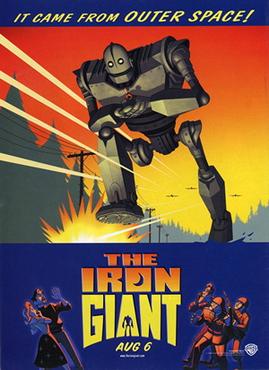
Seriously–great retro design, but definitely leaves a ‘stuff blows up!’ taste in your mouth.

It’s a great design–the retro styling has the 50’s sci-fi movie poster artwork down pat, and even directly quotes it with that most seminal of 50’s sci fi movies, It Came From Outer Space.

With the excitement of the action shot, and the robot dodging tracers from fighter jets, its easy to miss what he’s actually doing–he’s carrying Hogarth, the film’s human protagonist, as he runs for his life. The white lines made by the tracers draw your eye to the giant, but its easy to miss Hogarth clutched in his hands on a fast glance. This image is really the heart of the whole movie.

Here’s the recent dvd release cover art:

It Came From Outer Space to Learn Stuff About Having a Moral Compass
Thoughtful, much more slower-paced, lots of blues and greens

Very different, No? Leads you to memories of ‘E.T.: The Extraterrestrial,’ which is a much more apt comparison for this movie. Imagine if E.T. had been fifty feet tall, was a deadly walking weapon, and had the mind of a child.

Which is a shame, because what the filmmakers had on their hands (and probably knew it) was the E.T. for the Internet generation.

I may be biased because I am a huge fan of the film’s central message of personal accountability — the giant has been constructed as a weapon, a conquerer of worlds, but when he crash-lands on earth his memory is reset and he has amnesia. Enter Hogarth, an imaginative loner and only child, who finds the Giant and after a few bumps, becomes friends with him. Hogarth teaches the Giant that he is not what he is made to be, but rather, he is who he chooses to be.

I am a huge fan of personal accountability, in life. I think it’s up to every person to be the best person they can be, to try. The reason is because through that continual process of self-improvement, a person will find things out about themselves that they may have never known otherwise. How can you know your limits if you don’t push them? How can you know what tempts you if you’ve never known temptation? I guess I am making a big positive assumption about my fellow man–after all, a lot of people are capable of doing quite horrible things, but the point of all this is knowing yourself so that you know what harm you are capable of doing to others, and then not doing it. I know it’s convoluted, but it’s simple once you get down to the bare bones of it–Know Thyself. Just like the Greeks had over the doorway of the temple at Delphi, it is your responsibility to know yourself and be responsible for yourself, to take ownership of both your flaws and your good qualities.

This philosophy is also illustrated by the Giant himself–he’s 50 feet tall, and can do some SERIOUS damage if so motivated, or even if he’s just talking a walk. If he isn’t aware of his own movements he could easily crush Hogarth, or someone else, or even wipe out the whole town.When his weapons array is triggered later on, you see how easily he could dominate the whole earth, or worse, how a small force of Iron Giants could do the same.

Iron Giant is set during the height of the Red Scare in the 50’s, when the U.S. is bitter over the success of Sputnik and the Russian space program, and paranoia is everywhere. Suddenly the world was much smaller, and there was much less elbow room for the bigger countries, and worrying too much about what your neighbor (on a global and personal scale) was doing was just what folks did.

One wrong move, and a splat, a weird smell, and no more Hogarth.

Another great thing about the film are the supporting characters – a grab bag of 50’s tropes that could have been really shallow and one-dimensional, but who were so well-written that they really are worth a second look. There’s Hogarth’s mom, a single mother and waitress; Dean, the local beatnik scrap metal-artist (voiced by Harry Connick, Jr. in a really nuanced and great performance); even Kent Mansley, a pain in the ass G-man out to expose the giant and destroy it is well-fleshed out. He’s a man with ambition but no morals or concern about others or the ramifications of his own actions, and is essentially the polar opposite of the giant. Even General Rogard, a second-string character has unusual depth–aware of his responsibilities to the WHOLE nation, he must consider the potential risk in the idea of destroying a town of Americans in order to destroy the giant, and finds the idea horrifying and distasteful.I liked how the military wasn’t shown to be a bunch of single-minded drones; even though this film came out on the heels of the 90’s, when government plots were usually hand in hand with Sci-fi, based on the success of the X-Files.

What’s additionally interesting about Iron Giant are the questions that aren’t answered–and really, it’s a stronger story that way. It doesn’t matter, after all, it’s what he chooses to be that is the point.

Any way you slice it, Iron Giant is an instant classic, to borrow a phrase that has been overused to the point of cheapening its meaning–the movie really is a spectacular film for children, although maybe not very young children, given a few scary, intense moments. It’s literally a movie for all ages, since even at 32 years old I found it wonderfully intelligent, moving, and exciting at once.

Additionally, it was directed by Brad Bird, the genius behind The Incredibles and Up, and used to be involved with the Simpsons. Vin Diesel voices the giant (this was just as he was hitting it big), and there are a host of recognizable voices in the background of the story, all lending considerable weight to what oculd have been throw-away characters.

The Iron Giant is available on Instant Watch. You should go watch it RIGHT NOW.

How To Utilize The Spectacular ‘Reverse Highlander’ Maneuver

'I wonder what Sean Connery's up to right now?'

The scenario:

At a party/lunch/work function/bar/medical convention, a conversation is going well, but dangerous territory is broached.

The Enemy: ‘What’s your Favorite [insert media example here] of all time?’

The Victim: ‘Oh gosh, there are so many, I don’t know, I can’t think of anything, I…I guess [you blurt out the title of some widely-acknowledged lesser exponent of an artist’s creative oeuvre, ie Prince’s ‘Under the Cherry Moon’ instead of ‘Purple Rain’ or Clint Eastwood’s ‘Paint Your Wagon’ instead of ‘Unforgiven’].

YOU HAVE DIED.

My hypothesis will prove that within a certain set of predetermined enviromental factors, game will not be present.'

Socially, anyhow.

How to avoid such a fate? Where is the reset button of life?

There isn’t one, but those who aren’t willing to learn from history are doomed to repeat it!

If you had known the maneuver known (in my head) as the Reverse Highlander, this wouldn’t have happened.

Are you ready to learn it?

‘So what’s your favorite [blahblahbla] of all time?’

Step One:  ‘Well, there can’t be only one.’

See what I did there?

Step One allows you time to gather your thoughts, organize, and target them instead of just shotgunning them all over the face of whoever you’re speaking with. I fully realize that the average person does not live in fear of conversational faux pas like long pauses, losing one’s train of thought or stuttering, but there’s no harm in being prepared and practicing good conversational skills.

Step Two: You’ve gathered your thoughts, and can now progress with the conversation like a stone cold orator, which if I know kids these days is every kid’s dream.

‘Of course I enjoy [Neil Gaiman’s film adaptation of Coraline/most of his books/his accent] but there can’t be only one favorite. And even though it landed heavily on the side of suck, there was something fun about his Beowulf adaptation.’

And that kids, is the Reverse Highlander.

Because there can’t be only one.

Pictured: Game

Fun Friday: Remo Williams – The Adventure Begins…

The 80’s was a time of excess.

File that understatement along with others such as ‘Salma Hayak is attractive’ and ‘I enjoy dairy products.’

Isn't it amazing someone signed off on this artwork?

When the 80’s movie action ball really started rolling, you got the A group of Schwarzeneggar, Stallone and Willis, then the B group of Lundgren and Van Damme, then the C group of Dudikoff and Jackie Chan.

Way on down the alphabet, somewhere around the weird numbers like ‘Q,’ you’ll find Fred Ward as Remo Williams.

The movie is subtitled ‘The Adventure Begins’ because it was based on a ‘men’s adventure series’ of books with names like ‘The Destroyer.’ It was intended to be the first of a series, but since the first movie never really caught fire the series was abandoned.

There are a couple reasons why the movie didn’t catch fire–the action scenes are lackluster, the villain not that engaging (although he could have been; he’s an arms manufacturer creating faulty weapons and scamming the US military), and the movie gets off to a slow start.

But before we get too much into it, let’s talk about the elephant in the room:

Can you spot the authentic Asian man in this picture? Neither can I, because there isn't one.

Chiun.

Chiun is Williams’s Korean mentor, teaching him everything from martial arts to what not to eat (hamburgers). From him Remo learns how to fight, how to climb stuff, how to dodge bullets and run on water.

The problem is that Chiun, though he is a fantastic character and his chemistry with Remo carries the film at times, is not an Asian man.

Not at all.

In what is either an inspired or monstrously insensitive casting choice, Chiun was played by veteran actor Joel Grey, best known as the Master of Ceremonies in Cabaret and father of 80’s actress Jennifer Grey. The makeup was so convincing that it was nominated for an academy award but lost to Mask.

Adorable! But Adorable =/= Asian.

The use of Yellowface in movies has rarely stirred the same kind of discussion that blackface has, yet it’s no less offensive to the minority it seeks to depict.

Now, there’s a place for it. I think part of what makes a good actor is the ability to create believable characters, and if you can create a character that’s nothing like yourself and it’s still compelling, you’ve done something. It’s probably little consolation that the filmmakers hired one of the best actors of the time to portray Chiun, mostly because there are real Asian actors struggling to get any work in Hollywood.

The bottom line for me is that I didn’t even know a white man played Chiun until I watched the movie last night, and I grew up watching this film. I saw Joel Grey’s name in the credits and thought ‘Huh, I wonder who he plays?’ Then I noticed how there were so few names in the opening credits, had a brainwave, and cringed. “Oh god, they DIDN’T.’

But they did. And you know what? Grey is pretty convincing. It helps that the character is actually well-written: Chiun is Korean, fiercely proud of his heritage and way of life, disdainful of Williams and his lazy American lifestyle, and when he isn’t training Williams is usually seen eating traditional Korean dishes, practicing calligraphy, or watching his soap operas. He is proud of what he’s accomplished with Williams, but would never admit it to the man’s face.

It helps that the film’s writers had dozens of books and some already well-fleshed out characters to draw on–again, it’s hard to accept that they were unable to find a Korean or at least Asian actor to portray Chiun, but I think they were looking for something other than complete authenticity. Remo Williams doesn’t necessarily wink at the audience, but there is some element of self-awareness to the film–it’s in the ludicrous stunts, and just in Fred Ward’s self-effacing, blustery performance. Hell, they got his name off the bottom of a bedpan!

Kate Mulgrew, best known as Janeway from…one of the Star Trek shows that is not Original Series or Next Generation and therefore I know nothing about, puts in a convincing performance as a Major investigating the corrupt arms dealer. It was weird seeing a strong, self-directed woman character in this movie, as entrenched in 80’s action cliches as it is,  but there she was, a breath of fresh, ball-busting air.

Bottom line: Remo Williams is a weird, fun actioner ahead of its time in some ways, and strangely staid in others. Ward has a passing charm as a leading man, if only because of his blue-collar,  hangdog approach to the world, and he clearly has done some of his own stunts–his face is easily viewable in a few scenes.

This movie has me interested in tracking down some of the books. Apparently there are over a hundred in the series by now, and they’ve been going since the 70’s–with such ample room for character development there’s probably a lot of good stuff being missed out on.

Remo Williams is available on Instant Watch.

Coraline and the color palette of childhood

Here’s the short version of this entry: I just love Coraline.

Look out, world!

There haven’t been a lot of movies made in the last ten years that I can watch over and over again and still enjoy, that offer a really escapist feeling, that I’m not distracted by overblown production values or weak performances; Coraline definitely falls into that category.

There’s something beyond reproach about it. That’s not to say it doesn’t have flaws, but when you’re completely engrossed in the liquid grace of the stop motion puppetry, the textures of the world, sharp writing, brilliant characterizations, and beautiful music,  it’s easy to forgive.

There’s also the beauty of the color palette.

We first meet Coraline as she moves into a depressingly drab house on a gray, late-winter day. Dead trees cluster in the background, and a slate sky drops rain. Her parents are just as drained, with good reason: her beige-sweater sporting Mom was recently in a car accident and also wears a neckbrace, and Coraline’s dad resembles the microwavable version of Adrien Brody.

I shouldn't make fun, I'm only a few steps away from this myself.

From a child’s standpoint, Coraline’s parents might be viewed as selfish and neglectful; an adult looks on their attempt to focus on their desperately-needed work and sympathizes. After all, without the catalogue, the family doesn’t eat, since they’re freelance writers.

There were even a few moments when their plight seemed more serious than Coraline’s, and her whining for their attention made her less sympathetic and seem overly-self centered, even for a child.

It’s a depressing world for anyone, and an intelligent child like Coraline is doubly affected.

Which is where the color palette comes in.

I'd watch this cooking show. Hell, it's less terrifying than anything Paula Deen can come up with.

When the Other Mother builds a world to tempt Coraline, she fills it with lush, warm colors and luxuriant textures. The delicious food, the wallpaper, furniture, clothing, and plants of the Other World radiate color, almost drown the viewer in hues. My DVD came with a 3D version of the movie (and glasses! SO COOL!) and I haven’t given that a spin yet, but I hope it’ll be worth all the kerfuffle.

The color palette of childhood is simple, visceral. We want to wear our straw hats with our green pinafore and orange sweater and blue sock, possibly while wearing fairy wings or a tail, if we’re fairly young. Therein lies the appeal in the colorful mishmash of Coraline’s outfits: her pink dress and green tights, or the green and orange gloves she covets which her mother initially rejects have an individualistic charm to them, but also symbolize the time in our lives when we still did things for ourselves rather than others.

Once in high school a girl in my class was horrified with embarassment when a teacher pointed out the girl was wearing brown shoes with a black belt. I took this lesson to heart and swore never to make the same faux pas; now I could give a shit, although I do tend to shy away from bright colors.

From early high school until just two years ago, I wore black, gray, and if I was feeling saucy, purple or red. That was it. I was terrified of wearing The Wrong Thing together, and those four colors made me feel safe. Somehow, I forgot that wearing clothing had everything to do with what I liked, and nothing to do with what other people wanted. Inch by inch I’ve crept away from that security blanket, and now wear bright greens and blues, as well.

Now, I am seriously covetous of Coraline’s Other Outfit, which the Other Mother has made for her.

Cringing Genius Nerd and Horrific Ghost-child sold separately.

Part of the reason I like it is because the stars remind of me of the character Eleanor from Shirley Jackson’s Haunting of Hill House.

You don’t need to know the whole story of Hill House if you don’t already; what you need to know is that Eleanor is a shy, vulnerable woman bullied for years by her mother, who decides to take part in an experiment mostly as a way of asserting herself. As she drives to the house, she imagines a destiny for herself that is extricated from her overbearing mother: she’ll have a house some day, with stone lions guarding the front door, and she’ll drink from a cupful of stars. In short, she’ll do what SHE wants, HOW she wants, WHEN she wants.

The cupful of stars thing has always stuck with me, and when I saw the color and design on Coraline’ shirt it reminded me forcibly of Eleanor’s cupful of stars. It reminded me of those childhood things I’d given up or lost, most of all the intangible ones.

A person can live without their old toys, but not without the imagination that brought them to life.

There’s merit to the putting away of childish things as you become an adult, but finding a balance–neither giving up entirely on childish things nor retreating back into them–is what most people struggle with.

So I’d like to raise a cupful of stars to Coraline, for helping me find some of those things I thought I’d lost.

I actually found a woman on Etsy who’ll make the sweater, and while the child part of me wants it now, NOW, the adult part of me insists I wait until I actually can afford to drop 150 dollars on a sweater.


4 Badasses You Never Saw Coming

The Man With No Name, James Bond, Dwight McCarthy, Lara Croft, Indiana Jones, Marv, Al Swearingen, Titus Pullo, Tony Soprano, Han Solo.

Badasses are in no short supply these days–you could come up with probably five off the top of your head, and hands down everyone would agree ‘Yup, pretty badass.’

But what about unexpected badasses? Those badasses who don’t come immediately to mind but nevertheless can ‘tho down’ when necessary? What about badasses that come at you sideways?

Today’s entry is all about 4 Badasses You Never Saw Coming.

4. Princess Leia.

Way more than a steel bikini no matter what a Google Image search says, Princess Leia is more than capable of Throwing Down when necessary.

Just a small girl and her Big Gun

To wit: We meet Leia when she is running from the cops–that might not sound so badass, but consider what running from the police got her: dropped like keys into a storm drain.

Storm Troopers don’t know the meaning of the words ‘civil rights.’ That’s why the Galactic Empire is evil–because they do whatever the shit they damn well please, which is why rebels are even more badass in this situation: breaking the rules gets you zapped with lasers. And lasers are HOT. They burn through things. Sometimes those things are meaty, because they are people.

Consider also that Leia fed the Imperials bogus info concerning the rebel base–knowing full well they’d figure that shit out. Then she WATCHES while her home planet/family/pets/house/neighborhood/wallet/everything in her entire life, gets blown to hell. She’s definitely upset, but she also WATCHED HER HOME PLANET GET DESTROYED and still didn’t give up the real rebel base. Leia knows what the stakes are–keep silent and one planet gets destroyed, talk and LOTS of planets get destroyed. Considering that the death star’s main purpose is, you know, destroying planets.

In this rare exception, it might have been better for Alderaan to run from the police.

3. Babe The Pig

Who’s a good piggy? WHO’S A GOOD PIGGY?

ANSWER ME DAMMIT! I DEMAND TO KNOW WHO'S A GOOD PIGGY!

Babe the Pig is, and by and large, he’s a bonafide hero.

After all, on the one hand, he saves the farm (twice!), stands up to feral dogs and disapproving orangutans, faces a terrifying elderly clown and saves a bull terrier in one of the most moving and humane moments in film.

Some day I’ll get drunk enough to post my semi-hysterical and embarrassingly earnest review of Babe: Pig in the City, but today is not this day. Today is for Babe, and our other unsung badasses.

Watch this clip and tell me this pig doesn’t have guts.

Could YOU turn around and face an oncoming bull terrier bigger than you?

2. The Mad Hatter

Back in the Old West, you judged how ridiculously badass a gunfighter was by how outlandish and insane their outfit.

This would be the equivalent of holding a Desert Eagle and many shooting trophies in your hands at all times.

The logic went that if someone was fool enough to dress like a pretty pretty princess, they were the walking equivalent of an apocalypse.

From Doc Holliday to Wild Bill Hickok, who never met an ascot he didn’t like, nature’s maxim of  ‘the brighter the plumage the more serious the danger’ was for a brief time, applied to humans. What had been true of insects and poisonous plants for millions of years finally, and gloriously, applied to mammals.

Enter the Mad Hatter, Alice’s long lost friend and guide to the weirdness she finds through the mirror in the recent Tim Burton adaptation.

'At My Signal, Unleash Hell. And Cucumber Sandwiches.'

The statement his outfit makes is nothing short of a declaration of war on every living being on Earth.

There are alien satellites observing this shit and transmitting this declaration back to their home planets, and in about five thousand years a bunch of Lovecraftian horrors will land and demand to know where the BeHatted One is so they may kill him and bring order to the galaxy, Dagon Style.

But consider also the weapon the Hatter shows up with at the third-act battle:

The Hatter Comes Heavy.

That is a CLAYMORE. The folks who used them were called Highlanders, and the only thing that differentiates Highlanders from Vikings is that they wear plaid. Nothing else.

Here is a demonstration of what Claymores can do. It is worksafe and very entertaining, if by entertaining you mean HOLY SHIT LOOK WHAT THAT SWORD CAN DO. Please also note the hefty fellow waving that pigsticker around–if a weedy little fellow like the Hatter is using one, then it means his eyes probably got that way through a constant and consistent application of Angel Dust. Not the man you want to be facing on the battlefield.

1. Mr. Faun Tumnus

'Would you like to walk back to my house? I seem to have misplaced my big white molesty van!'

When first we meet Mr. Faun Tumnus in the recent Chronicles of Narnia adaptation, he’s a timid little fellow who drops his shit and screams when surprised by the terrifying countenance of a small girl.

He gets wild by breaking into the sardines, and making hot tea. He is adorable, except he has goatlegs and entertains children without wearing pants. Or maybe for some folks, that’s a plus. It’s a big world out there.

Anyhoo, we realize this is all a big act. Later on, once all the statues have been brought back to life, Tumnus is more than ready to plow furrows across the White Witch’s ass and he heads down to the battlefield to do it…

…in nothing but a fancy red scarf.

There was a name for the guys who used to go to war without clothes on: psychopaths Berserkers.

Mr. Tumnus hasn’t brought armor, or even a weapon. He IS the weapon.

I have figured out the secret of Faun Tumnus, and it is that he is a Berserker. He doesn’t have the spear and the wolf pelt, but just give him a few minutes and he’ll have a pile of them–taken from the enemy and dumped on the field.

You only see a brief scene of him running towards the battlefield, but it’s because ostensibly this is a children’s movie and watching a goatman tear monsters apart with his bare hands and then eat their organs would incur at least a PG-13 rating.

No more child molestation jokes. Seriously.

Additionally, Mr. Tumnus has HOOVES. Which are hard little pointy things.

It’s bad enough being kicked in the face by a human foot, imagine taking a hoof to the face–it be like being bludgeoned.

Now imagine that foot belongs to the mythological equivalent of Bruce Lee, and realize that Mr. Tumnus was the Narnians’ secret weapon all along. Aslan was just there to tell him where to go.

There are dozens, hundreds more unsung badasses to go, but I hope you enjoyed this little sampling. As always, there’s More To Come.