Additional Thoughts: The Iron Giant

I think one of the most poignant scenes of this movie is the moment we finally get to see humanity from the Giant’s perspective: after Hogarth tells him that the bomb will kill everyone, he looks down at all the little people scattered on the ground before him, and at the shops and buildings no bigger than snackboxes. With a few strides of his legs he would be free of the blast radius, or he could simply fly away. It’s just a little place on a world he isn’t from, and he doesn’t have to be a part of its problems at all.

Here is the original write-up that I did of the Iron Giant a few years ago.
Brought to you in Fan-TAST-A-Vision!

Last night I watched it again and had a few additional thoughts that I wanted to get down.

1. The Post-War Setting

Hogarth’s father has been killed in action, that much we can get from subtle hints through the movie:

  • Hogarth’s Mom is having financial difficulties and works as a waitress, renting out the room in their large house.
  • There’s a photo of a man climbing into a vehicle cockpit on Hogarth’s bedside table
  • One of the pictures that Mansley develops from Hogarth’s camera is of both Hogarth and his mom, begging the question, who took the picture? I’m guessing his Dad, before he went away
  • Annie calls Dean “sweetie” at the movie’s end and has clearly developed a relationship with him, indicating Hogarth’s dad is permanently out of the picture (unless Annie is rocking some seriously progressive relationship dynamics).

But there was something I noticed about twenty minutes in. I had absorbed it but never really thought about the other people in the town – it’s almost all women, kids, and older men. And I realized that it’s because all the younger men were called up for service in the war. And more than likely, didn’t come back. If that’s something intentional on the part of the filmmakers, then BRA-VO. That is a beautifully subtle reality of post-war life.

If this is accurate, then it also adds another layer of subtlety to Dean and Mansley’s characters – Dean might be a conscientious objector; the way the other men in the diner sort of dismiss him could just be because of his beatnik stylings, but it could also  be that he’s thought of as a “draft dodger.” And Mansley was left behind because he’s just plain incompetent.

2. Hogarth’s Reaction to Death 


OUCH!

Hogarth is a sensitive, intelligent, and creative boy. He saves the Giant when the latter is endangered at the power station. When the Giant destroys the traintracks, he is horrified at what could happen. When he and the Giant encounter the deer and the hunters, he gently tries to describe what happened to the deer, and is incensed when the Giant tries to pick the body up.

Additionally, he has a serious talk with the Giant about souls and what happens when you die. He quotes his mother’s belief in souls, and I imagined his mother having this discussion with him after his father passed away. It’s a terrible thing, to bury a loved one, and he doesn’t want anyone to experience what he went through, especially not at his expense.

3. Hogarth As Father Figure

Hogarth finds this creature, takes him in, and extends hospitality to him. He helps him find food, and a safe place to stay. He becomes the Giant’s protector, in a lovely role reversal. It’s not every ‘boy’s movie’ where the main character is a protector or nurturer. At very few times during the movie is Hogarth in danger – it’s the Giant who is in the most danger. At the end, Hogarth again saves the Giant by arguing with the General that he is not dangerous, although Mansley borks that plan by grabbing the telecom and commanding the Nautilus to fire its atomic weapon. The boy and Giant are literally following the roles of Jonathan Kent and Superman, and just as in that story, the child (Giant) matures and assumes the role of protector.

I think one of the most poignant scenes of this movie is the moment we finally get to see humanity from the Giant’s perspective: after Hogarth tells him that the bomb will kill everyone, he looks down at all the little people scattered on the ground before him, and at the shops and buildings no bigger than snackboxes. With a few strides of his legs he would be free of the blast radius, or he could simply fly away. It’s just a little place on a world he isn’t from, and he doesn’t have to be a part of its problems at all.

The Giant is destroyed in his role as protector, but as we see at the end of the film, he isn’t really gone. He’ll be back, and OMG I get emotional just WRITING about it. And Hogarth has a father figure again, both in Dean, and in the Giant, who’ll be returning soon.

4. Giant as Russia

Obviously, the film’s big themes are the Atomic Age and beginning of the Cold War. Dean literally tells the General that the Giant “will not attack unless he’s attacked first,” which was the entire situation of the Cold War. There’s even a joke about the Giant not wanting to be Atomo, the atomic robot villain.

Additionally, the fear and hatred whipped up in the townspeople by Mansley is also ephemeral once they realize the Giant poses no threat, and is even as invested in peace as they are. And, just as in nuclear holocaust, when you’re about to die the lines between hero and villain kind of fall away, since there’s no time left for such distinctions.

So those are the thoughts I thunk while watching it again last night. I do love a good, layered film that makes you think, and that you can see differently if you go back to it.

I hope you’re having a great day! If you haven’t checked this movie out, you might. It’s not on Instant at the moment but it’s widely available elsewhere.

Just, you know, maybe bring some tissues!

Theater Release: Muppets’ Most Wanted

Bret McKenzie of Flight of the Concords fame is the music supervisor. In some ways it’s a long jump between Bowie’s in Space and the Muppets, but it also isn’t. Witty lyrics, catchy tunes, goofy jokes, and just good, solid songsmithing is at the heart of the Muppets.

Group picture of the muppets with 3 humans standing behind them

Last night my boyfriend took me to our favorite theater to see Muppets Most Wanted. It was a jolly good time I had to say.

Besides the jokes and general Muppetry being spot-on to the spirit of the Henson era, it also evoked a lot of Cold War nostalgia since the Russians are sort of the bad guys. Tina Fey stars as the head of the Siberian Gulag where Kermit is wrongfully incarcerated, due to a case of mistaken identity.

Ricky Gervais, Ty Burrell, Tina Fey and a host of cameos round out the cast, and I wish that the movie had been longer so that there was more for the rest of these actors to have more screen time.

So far it hasn’t made as much as the previous film, but I really hope it becomes a sleeper hit. It was just as adorable as the last installment, and the songs in some cases I enjoyed even more.

Bret McKenzie of Flight of the Concords fame is the music supervisor. In some ways it’s a long jump between Bowie’s in Space and the Muppets, but it also isn’t. Witty lyrics, catchy tunes, goofy jokes, and just good, solid songsmithing is at the heart of the Muppets.

As I child I remember seeing actors in the Muppet movies and wondering what other movies they had been in, and most often, they were in movies that were either over my head or weren’t exactly family entertainment. That noble tradition is carried on here, as some of the cameos include Christophe Waltz, Til Schweiger, Saiorse Ronan, Hugh Bonneville, Jermaine Clement (who I initially mistook for Benecio Del Toro in full shaggy weirdo mode) and Danny Trejo. Or at least I associate those actors with entertainment that’s not family friendly, unless your family is watching a lot of Quentin Tarantino movies.

Muppets Most Wanted is in theaters now. Go see it! Go! Go!

Ultimate Children’s Movies: The Iron Giant

Iron Giant is set during the height of the Red Scare in the 50’s, when the U.S. is bitter over the success of Sputnik and the Russian space program, and paranoia is everywhere. Suddenly the world was much smaller, and there was much less elbow room for the bigger countries, and worrying too much about what your neighbor (on a global and personal scale) was doing was just what folks did.

“You are who you choose to be.”

The Iron Giant is one of my favorite movies, easily. And yet I didn’t see it until about  a year ago, probably for the same reason a lot of people missed it–the marketing campaign.

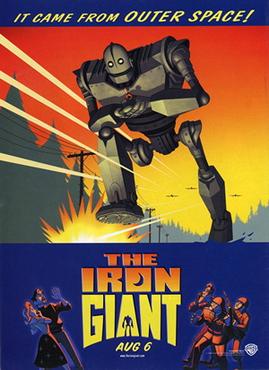
Here’s the imagery of the original ad campaign:

Seriously–great retro design, but definitely leaves a ‘stuff blows up!’ taste in your mouth.

It’s a great design–the retro styling has the 50’s sci-fi movie poster artwork down pat, and even directly quotes it with that most seminal of 50’s sci fi movies, It Came From Outer Space.

With the excitement of the action shot, and the robot dodging tracers from fighter jets, its easy to miss what he’s actually doing–he’s carrying Hogarth, the film’s human protagonist, as he runs for his life. The white lines made by the tracers draw your eye to the giant, but its easy to miss Hogarth clutched in his hands on a fast glance. This image is really the heart of the whole movie.

Here’s the recent dvd release cover art:

It Came From Outer Space to Learn Stuff About Having a Moral Compass
Thoughtful, much more slower-paced, lots of blues and greens

Very different, No? Leads you to memories of ‘E.T.: The Extraterrestrial,’ which is a much more apt comparison for this movie. Imagine if E.T. had been fifty feet tall, was a deadly walking weapon, and had the mind of a child.

Which is a shame, because what the filmmakers had on their hands (and probably knew it) was the E.T. for the Internet generation.

I may be biased because I am a huge fan of the film’s central message of personal accountability — the giant has been constructed as a weapon, a conquerer of worlds, but when he crash-lands on earth his memory is reset and he has amnesia. Enter Hogarth, an imaginative loner and only child, who finds the Giant and after a few bumps, becomes friends with him. Hogarth teaches the Giant that he is not what he is made to be, but rather, he is who he chooses to be.

I am a huge fan of personal accountability, in life. I think it’s up to every person to be the best person they can be, to try. The reason is because through that continual process of self-improvement, a person will find things out about themselves that they may have never known otherwise. How can you know your limits if you don’t push them? How can you know what tempts you if you’ve never known temptation? I guess I am making a big positive assumption about my fellow man–after all, a lot of people are capable of doing quite horrible things, but the point of all this is knowing yourself so that you know what harm you are capable of doing to others, and then not doing it. I know it’s convoluted, but it’s simple once you get down to the bare bones of it–Know Thyself. Just like the Greeks had over the doorway of the temple at Delphi, it is your responsibility to know yourself and be responsible for yourself, to take ownership of both your flaws and your good qualities.

This philosophy is also illustrated by the Giant himself–he’s 50 feet tall, and can do some SERIOUS damage if so motivated, or even if he’s just talking a walk. If he isn’t aware of his own movements he could easily crush Hogarth, or someone else, or even wipe out the whole town.When his weapons array is triggered later on, you see how easily he could dominate the whole earth, or worse, how a small force of Iron Giants could do the same.

Iron Giant is set during the height of the Red Scare in the 50’s, when the U.S. is bitter over the success of Sputnik and the Russian space program, and paranoia is everywhere. Suddenly the world was much smaller, and there was much less elbow room for the bigger countries, and worrying too much about what your neighbor (on a global and personal scale) was doing was just what folks did.

One wrong move, and a splat, a weird smell, and no more Hogarth.

Another great thing about the film are the supporting characters – a grab bag of 50’s tropes that could have been really shallow and one-dimensional, but who were so well-written that they really are worth a second look. There’s Hogarth’s mom, a single mother and waitress; Dean, the local beatnik scrap metal-artist (voiced by Harry Connick, Jr. in a really nuanced and great performance); even Kent Mansley, a pain in the ass G-man out to expose the giant and destroy it is well-fleshed out. He’s a man with ambition but no morals or concern about others or the ramifications of his own actions, and is essentially the polar opposite of the giant. Even General Rogard, a second-string character has unusual depth–aware of his responsibilities to the WHOLE nation, he must consider the potential risk in the idea of destroying a town of Americans in order to destroy the giant, and finds the idea horrifying and distasteful.I liked how the military wasn’t shown to be a bunch of single-minded drones; even though this film came out on the heels of the 90’s, when government plots were usually hand in hand with Sci-fi, based on the success of the X-Files.

What’s additionally interesting about Iron Giant are the questions that aren’t answered–and really, it’s a stronger story that way. It doesn’t matter, after all, it’s what he chooses to be that is the point.

Any way you slice it, Iron Giant is an instant classic, to borrow a phrase that has been overused to the point of cheapening its meaning–the movie really is a spectacular film for children, although maybe not very young children, given a few scary, intense moments. It’s literally a movie for all ages, since even at 32 years old I found it wonderfully intelligent, moving, and exciting at once.

Additionally, it was directed by Brad Bird, the genius behind The Incredibles and Up, and used to be involved with the Simpsons. Vin Diesel voices the giant (this was just as he was hitting it big), and there are a host of recognizable voices in the background of the story, all lending considerable weight to what oculd have been throw-away characters.

The Iron Giant is available on Instant Watch. You should go watch it RIGHT NOW.

‘My God, Someone Paid For this To Be Made’ Entry — GI Joe: The Rise Of Cobra

GI Joe starts out in France in 1611. I know, because despite the fact taht I was drunk, I took copious notes. They are stained and festooned with question marks and mad scribblings, but overall still valid.

What kind of bullshit is that? FRANCE? WHAT?

Asinine. Who gives a shit about the historical heritage of Cobra. Please raise your hands if you were demanding historical significance from a movie based on toys that you played with in the sandbox or bathtub.

Once upon a time, I had a vision.

A glorious vision, the sort of vision that got people burned as heretics in the Dark Ages, yet was no less true for its ostentatiousness.

I dreamed I stood on a cliff, staring out at a roiling sea. Clouds skirted the horizon, the sun burned like a vengeful eye, and below me the cliffs were alive with plumes and torrents as the sea crashed and raged.

A sea of absolute bullshit.


And don't tell me, 'Oh, it was based on toys, what do you expect?' You know what else was based on toys and won buttloads of awards? 'TOYS.'


It’s possible I was biased against the GI Joe movie from the very start. Watching the trailers gave me a horrifying clarity, a window into what it must be like to be an epileptic who habitually gets trapped inside a washing machine full of neon lights, pleather, airborne vehicles and shitty laser effects.

Now, I played with Joes as a child, albeit I didnt’ play by the rules. For some reason I was stuck on monsters and aliens mode, so the only Joes I had were ones that had animal sidekicks, or some kind of weird mutation. I had Spirit Wind, the Military MP guy (his German Shepherd was a werewolf to my Lego people), Killer Croc, Outback (warthog accessory! BOSS!) Some kind of guy with a Cobra as a hat, and Big Boa, because he came with removable and adorable boxing gloves. I didn’t give a shit about patriotism, vehicles (Except that crazy ass Cobra Commander flying skiff, that was amazing) robots, guns, or tanks. It was also common for GI Joes to go to war with the mutants of Outworld, which were comprised of my He-Man and Ninja Turtles figures.

I went into the GI: Joe movie thinking ‘Well, I’ve had like nine beers, and even folding laundry has usually become fun by then. Therefore, this will be fun.’ Ipso, facto.

My fake Latin philosophy math was wrong.

Watching GI: Joe – The Rise of Cobra was incredibly similar to being in a car accident, and I’ve been in no less than 5 in my life so I know what I’m talking about. There’s a lot of noise, a lot of shit suddenly moves around, your whole perspective on life has changed but you aren’t sure why, you just know SOMETHING HAPPENED.

Which is what watching the film was like.

Usually, I pull my punches with hating on a movie, but By God and Sunny Jesus, I will NOT do so today. This movie was way, way too expensive to get the kid glove treatment.


This movie is also unforgiveable for wasting Adewale Akinouye -Agbage's time. I refuse to believe he doesn't have better things to do than this.


GI Joe starts out in France in 1611. I know, because despite the fact taht I was drunk, I took copious notes. They are stained and festooned with question marks and mad scribblings, but overall still valid.

What kind of bullshit is that? FRANCE? WHAT?

Asinine. Who gives a shit about the historical heritage of Cobra. Please raise your hands if you were demanding historical significance from a movie based on toys that you played with in the sandbox or bathtub.

Other scribblings from my note:

‘why is the military using a civilian H2?’ Nathan pointed that one out.

This observation was closely followed by ‘why are you questioning the logic of the GI:Joe movie?’

‘Duke- Dude can’t talk right. Sounds like he’s going blublubblubblub.’

Seriously. Channing Tatum, from his IMDB entry, seems sort of respected as an actor, and yet I could barely follow his dialogue because of his weird novocaine mumbly-mouth. Plus, the man’s eyes were so dead and glassy I could clearly see his paycheck reflected in their surface, because no other thoughts animated his corpus.

‘Science says emotions don’t exist? WHAT?’

Scarlett, that most cartoonish of hotties (and played by some girl with red hair and boobs, it’s totally not worth it to look her name up), makes this weird assertion as to why she won’t date Marlon Wayans (who MUST have better things to do than this movie, for christ’s sake, he was in REQUIEM FOR A DREAM) when he makes his move on her. This is not only story bullshit, it’s scientific bullshit. Science has no problem quantifying emotions–they’re caused by subtle synaptic shifts in hormones, by adrenaline, by all kinds of math and numbers and chemicals and things that ARE REAL. So being attracted to a dude is totally valid. She’s just a racist.


I was also enraged by the Baroness character.

Spies are also known for being inconspicuous, which involves wearing costumes rejected from the Underworld series as too cheap-looking and giant belt buckles.

A brief digression:

In the Preacher books, the villain, a scarred German psycho named Herr Starr, is teaching a course on how to deal with terrorists to some soldiers in an elite anti-terrorist recruitment facility. He begins his lesson with the words:

‘Shoot the women first.’

He goes on to explain that any woman who has worked her way up to the top of a terrorist organization has worked at least FIVE TIMES as hard as her male compatriots in order to have her skills and dedication recognized. In short, in any terrorist situation, you had best kill the va-jay-jays because THEY would pose the greatest threat to you, and kill you five times harder than a dude. Anything a dude can do, a woman has already done, alphabetized, collated, and buried in the backyard before he even thought of it.

GI:Joe posits that Cobra allows someone to totally half-ass their way to the top of the organization. In an elite, worldwide terrorist group, how does someone FAKE enthusiasm? HOW? Baroness’s residual love for Duke leads to the Cobra organization’s fall, suggesting that women can’t be trusted in these situations because they get all emotion-y and fall in love with men and shit. God forbid they handle firearms, their estrogen might gum up the firing pin.

Someone looked at this pic and said 'Yes! Cover one third of his face in burn makeup, the other half in a breathing apparatus, dress him in a shitty wig and hire him!'


Which  brings me to my next point:

Joseph Gordon-Levitt is adorable.

Just look at that face! So much spunk, so much character! You wouldn’t just have a beer with him, you’d want to take him home and show him your band trophies from high school.

He was the most fun thing about Rise of Cobra, and brought a much-needed feel of pseudo-camp to the shenanigans. After awhile, I realized I was patiently waiting for the ridiculous action setpieces to end so I could get back to the much more interesting story of Destro or whatever he was.

Dick move, Hollywood: if your film’s basically a multi-million dollar recruitment product for the armed forces, don’t make the villain more interesting than anything else happening onscreen. I even stopped giving a shit about Christopher Eccleston when Gordon-Levitt was onscreen. ECCLESTON.

Every few moments in GI:Joe, I found myself whistling or humming the main song from Team America: World Police. It’s a little ditty that goes something like ‘America…FUCK YEAH! Coming again to save the motherfucking day YEAH!’ What’s tragic is that movie, starring puppets and a metric ton of sarcasm, was a much more fun movie than this one, and it was much more honest about what was going on. It also got me a lot more excited about blowing shit up.

So in short–I know I watched the GI Joe movie, and I have all these residual flashbacks and strange images burned into my mind, but I just don’t know what actually HAPPENED. There was a desert and the Eiffle tower and an underwater city and some kind of nano tech mask or something. The sad thing is that I am smart enough to understand all this stuff–unlike a car accident, I can go back and relive the experience, articulating complex emotional ideas and pieceing together what actually happened.

I just don’t give a shit, though.

Coraline and the color palette of childhood

Here’s the short version of this entry: I just love Coraline.

Look out, world!

There haven’t been a lot of movies made in the last ten years that I can watch over and over again and still enjoy, that offer a really escapist feeling, that I’m not distracted by overblown production values or weak performances; Coraline definitely falls into that category.

There’s something beyond reproach about it. That’s not to say it doesn’t have flaws, but when you’re completely engrossed in the liquid grace of the stop motion puppetry, the textures of the world, sharp writing, brilliant characterizations, and beautiful music,  it’s easy to forgive.

There’s also the beauty of the color palette.

We first meet Coraline as she moves into a depressingly drab house on a gray, late-winter day. Dead trees cluster in the background, and a slate sky drops rain. Her parents are just as drained, with good reason: her beige-sweater sporting Mom was recently in a car accident and also wears a neckbrace, and Coraline’s dad resembles the microwavable version of Adrien Brody.

I shouldn't make fun, I'm only a few steps away from this myself.

From a child’s standpoint, Coraline’s parents might be viewed as selfish and neglectful; an adult looks on their attempt to focus on their desperately-needed work and sympathizes. After all, without the catalogue, the family doesn’t eat, since they’re freelance writers.

There were even a few moments when their plight seemed more serious than Coraline’s, and her whining for their attention made her less sympathetic and seem overly-self centered, even for a child.

It’s a depressing world for anyone, and an intelligent child like Coraline is doubly affected.

Which is where the color palette comes in.

I'd watch this cooking show. Hell, it's less terrifying than anything Paula Deen can come up with.

When the Other Mother builds a world to tempt Coraline, she fills it with lush, warm colors and luxuriant textures. The delicious food, the wallpaper, furniture, clothing, and plants of the Other World radiate color, almost drown the viewer in hues. My DVD came with a 3D version of the movie (and glasses! SO COOL!) and I haven’t given that a spin yet, but I hope it’ll be worth all the kerfuffle.

The color palette of childhood is simple, visceral. We want to wear our straw hats with our green pinafore and orange sweater and blue sock, possibly while wearing fairy wings or a tail, if we’re fairly young. Therein lies the appeal in the colorful mishmash of Coraline’s outfits: her pink dress and green tights, or the green and orange gloves she covets which her mother initially rejects have an individualistic charm to them, but also symbolize the time in our lives when we still did things for ourselves rather than others.

Once in high school a girl in my class was horrified with embarassment when a teacher pointed out the girl was wearing brown shoes with a black belt. I took this lesson to heart and swore never to make the same faux pas; now I could give a shit, although I do tend to shy away from bright colors.

From early high school until just two years ago, I wore black, gray, and if I was feeling saucy, purple or red. That was it. I was terrified of wearing The Wrong Thing together, and those four colors made me feel safe. Somehow, I forgot that wearing clothing had everything to do with what I liked, and nothing to do with what other people wanted. Inch by inch I’ve crept away from that security blanket, and now wear bright greens and blues, as well.

Now, I am seriously covetous of Coraline’s Other Outfit, which the Other Mother has made for her.

Cringing Genius Nerd and Horrific Ghost-child sold separately.

Part of the reason I like it is because the stars remind of me of the character Eleanor from Shirley Jackson’s Haunting of Hill House.

You don’t need to know the whole story of Hill House if you don’t already; what you need to know is that Eleanor is a shy, vulnerable woman bullied for years by her mother, who decides to take part in an experiment mostly as a way of asserting herself. As she drives to the house, she imagines a destiny for herself that is extricated from her overbearing mother: she’ll have a house some day, with stone lions guarding the front door, and she’ll drink from a cupful of stars. In short, she’ll do what SHE wants, HOW she wants, WHEN she wants.

The cupful of stars thing has always stuck with me, and when I saw the color and design on Coraline’ shirt it reminded me forcibly of Eleanor’s cupful of stars. It reminded me of those childhood things I’d given up or lost, most of all the intangible ones.

A person can live without their old toys, but not without the imagination that brought them to life.

There’s merit to the putting away of childish things as you become an adult, but finding a balance–neither giving up entirely on childish things nor retreating back into them–is what most people struggle with.

So I’d like to raise a cupful of stars to Coraline, for helping me find some of those things I thought I’d lost.

I actually found a woman on Etsy who’ll make the sweater, and while the child part of me wants it now, NOW, the adult part of me insists I wait until I actually can afford to drop 150 dollars on a sweater.