4 More Life Lessons from 80’s Movies

There is no saving Artax. He has reached his limit, and will not be moved. Atreyu can’t save his horse, because Artax doesn’t want to save himself–and when someone loses the will to live, even after the intervention of their friends and family, there’s little that will drag them back.

Every culture in the world will eventually produce a set of maxims for behavior; from the laws of Nebuchadnezzar, to the doctrines of Thomas Aquinas, to basic Internet Etiquette, there are morals and suggestions for human interaction everywhere–you could trip over them and someone would be there to tell you what you did wrong.

Oddly enough, I noticed a lot of 80’s movies had such maxims, and have been collecting them and posting them as I think of them. The first part of the list can be found here.

4. The Secret of Nimh – ‘Crying doesn’t solve anything.’

Sometimes, your best isn't good enough--whatever it is, it needs to get DONE.

Mrs. Brisby has some serious problems.

Her husband was recently killed in an accident, one of her three children is desperately ill, and she needs to move her family (including her house) to a new location, otherwise they will be crushed by the farmer’s tractor when it is time to harrow the field they live in.

Lady has a lot on her mind.

So when the tractor starts up unexpectedly, she and her friend Auntie Shrew (who I always thought of as one hardass bitch–she either had some messed up stuff happen in her life or did some time in Vermin Jail), who are both about the size of a lemon, take it on.

A mouse and a shrew take on a tractor.

While all the other animals in the field are hauling ass from the path of the tractor, Mrs. Brisby and the shrew are running towards it, screaming warnings. They reach the tractor, clamber up a loose chain, and begin scrambling about its interior in search of a way to shut it down. Brisby, faced with the prospect of falling into the churned earth the harrow blade turns up, shuts down, and can only cling to the tractor and shake. The Shrew winds up tearing out a crucial hose (oil?) and the tractor shuts down.

Later, as the two gather their wits in the high grass, Brisby breaks down crying over the ordeal, but also the recent traumas she’s faced.

Coldly, almost hatefully, the Shrew snarls at her to “Stop it.”

You'd be surprised how many good pictures there aren't of her.

The Shrew is disgusted, not by the display, but because Brisby doesn’t have the luxury of being selfish right now, of thinking about her woes and weeping. She needs to get her shit together and figure out how she’s going to save her children–when Brisby plaintively weeps ‘I wish Jonathan [her husband] was here’ you get a sense that Brisby was overly reliant on him, that he would have figured something out himself, saving her the trouble. She wants to be taken care of again, to have someone else fix her problems, and she doesn’t have that option anymore–it’s up to her.

Brisby is now a single mother. The rest of the movie consists of her learning how strong she truly is, as she faces terrifying creatures and learns to trust herself to do the right thing. I can’t think of another movie in recent years that so elegantly explores the plight of a single parent and all that it entails. Not a children’s movie about talking mice, anyway.

3. Legend – ‘Trust People.’

Who is our Generation's Tim Curry? What actor in recent years could step into these pants? WHO?

With all the fantasy trappings surrounding Legend–unicorns, goblins, fairies, pixies, wild boys in shorts, princesses, giant castles, monsters,  and a certain giant red campy fellow–it’s easy to lose sight of what the film is really about: trusting people.

Jack is a recluse, living in the woods with his animal friends and relaxed dress code. There’s a reason he’s there and not in the city, and it isn’t to save money on production costs–he’s a hermit, he doesn’t trust people. Only Lily, a spoiled Princess, can get close to him.

Which is why, when Jack takes Lily to see the unicorns and she ignores him, breaking a major rule and actually TOUCHING ONE, he loses his trust in her. He doesn’t know that the reason the unicorn freaked out was due to the goblins’ poisoned dart, or anything about the machinations of Darkness and his goblins. He thinks that Lily touching the unicorn is what ruined everyone’s day.

So though he spends the rest of the movie trying to make right what happened, and save her, it is also about him remembering to trust her, no matter what she’s done or how she’s changed. Remember, when he left her, she was all ‘Disney Princess Barbie,’ with the smiles and the charm and the giggling. When he finds her again, she looks like this:

If it doesn't fit, you improvise!

Since he dumped her, she’s been rooming and sharing clothes and makeup tips with Klaus Nomi Darkness, a red-skinned fellow with an infectious laugh and an even more relaxed dress code than Jack. They’re kind of like Mickey and Donald–Mickey (Darkness) wears pants, and Donald (Jack) wears a shirt–together they make a whole outfit.

Anyhoo, when Jack has to make his choice, he’s got a bunch of fairies yelling in his ear that Lily can’t be trusted, that she’s changed. His faith in her is an illustration of the pure goodness alluded to in the rest of the film–after all, being good means being good ALL the time, not getting to pick and choose when you follow the rules–the fairies hearts’ were in the right place but they don’t know everything, as is established earlier by Gump not being aware of Oona’s secret.  Jack trusts Lily–and the day is saved.

2. The Burbs – Idle Hands are the Devil’s Playthings

Dear Tom Hanks: Comedy misses you. Please take its calls again.

I miss the comedy films of Tom Hanks.

I haven’t seen too many of his dramas the last five years or so–no particular reason other than I already see more than enough dramas and have no interest in Dan Brown’s books.

But one upon a time, he made comedies. Fantastic, creative comedies the likes of which aren’t made anymore because of the lack of fart jokes and horrible people in them. Hanks took a middling comedy and elevated it to hilarity.

The Burbs is a comedy about a man who decides to spend his vacation lying around the house, drinking beer with friends and speculating on the new neightbors who have just moved in. He wants to garden, to vegetate, to putter, to wear his pajamas all day and relax.

But his bucolic rest is interrupted when he and his buddies begin inflating the importance of neighborhood events into something sinister–a missing neighbor, an errant toupee, the new neighbors digging in the backyard during a rainstorm in the middle of the night… conclusions are drawn and plans are made.

The lesson here (although it turns out that the neighbors WERE up to something unsavory) is that boredom can lead to invention the same way necessity can, the difference being that being bored usually gets people into trouble–boredom in a relationship can lead to cheating, boredom with a job leads to dissatisfaction and doing it half-assed, boredom with your life breeds a need for escapism.

Not only that, but The Burbs were one of those early movies that had the courage to suggest that maybe the good old days..weren’t so good? Like No Country For Old Men, it dared to present the idea that rose-colored glasses were a pretty poor medium for viewing the past.

1. The Neverending Story – When You’re Going Through Hell, Keep Going.

This is the big one for me.

 i
Just looking at it breaks my heart all over again

There are a lot of lessons to be learned from The Neverending Story–about following your dreams, about courage, about trusting people–but the one that always, always, always jumps out at me when I am watching it is that no matter how shitty things get, you have to keep going.

Depression is a pervasive illness many people don’t realize they have. It’s insidious, it creeps in and ruins your good times, pushes you away from happiness, makes you hurt others (this numbness, where the things you usually enjoy bring no pleasure, is known as ‘anhedonia’) . Many people think of depression as being sad for a time, as a period with a fixed beginning and ending. Depression is not being ‘down in the dumps,’  it’s a chemical imbalance that can become more or less pronounced, but never really goes away. It can be medicated, and combated with therapy, but at best you will learn how to manage it and live with it.

Enter the nefarious scene with Artax the horse–Atreyu tries to drag the horse bodily out of the swamps of sadness, and when the latter won’t move he becomes angry, screaming, insulting the horse, then just pleading and begging as the horse sinks deeper into the black muck. ‘Move, please,’ still brings tears to my eyes, every time I hear that barely-teenaged boy’s voice.

There is no saving Artax. He has reached his limit, and will not be moved. Atreyu can’t save his horse, because Artax doesn’t want to save himself–and when someone loses the will to live, even after the intervention of their friends and family, there’s little that will drag them back.

It’s a scene that doesn’t get the cinematic respect it should–I mean, the movie isn’t Schindler’s List, but it’s no Battlefield: Earth, either. It’s a moving metaphor for depression: after all, it’s easy to stop moving, but sometimes nearly impossible to get going again.

More than anything else, depression is what happens when you forget the feeling of joy, of hope. Remembering it, rediscovering that warmth and happiness, can be one of the most rewarding moments in your life, but my god, getting there can be an uphill battle.

He Kept Going.

Rip-roaring Rakish Entry: Plunkett and Macleane

The whole movie is a hoot–Carlyle is perfectly cast as a highwayman with a heart of gold with his soulful eyes and quick fists, and Miller as a debtor-turned-bandit with aspirations of nobility provides a compelling narrative. Alan Cumming appears as foppiest of the fops Lord Rochester, whose libertine attitude is only matched by the fantabulousness of his giant hats. This WAS the era of the Antoinette wig, after all, and giant wigs are ubiquitous. No little boats in them, though.

Yes. Yes You ARE having fun yet.

I’m a sucker for a good period piece–and when that period piece combines a contemporary music score, action, comedy, and a stellar cast including Robert Carlyle, Liv Tyler, Alan Cumming and Michael Gambon, I’d be sure I was hallucinating if I wasn’t already drunk.

I’ve been a Carlyle fan since ‘The Full Monty,’ and I’ve seen a large body of his work, both mainstream (Goldeneye, Trainspotting) and off the beaten path (Go, Now; that one about the dancing academy whose name I have forgotten–I missed the one about talking dragons though). Carlyle plays Plunkett, a former-apothecary turned highwayman with an opportunistic eye and a pragmatist’s spirit; though he is excellent at robbing the wealthy English of the 1740’s setting, he sees his crime career as a means to an end: he wants to get enough money to leave England and move to America where he can make a new life for himself. His talents for chemistry are a nice flourish for his character, giving an otherwise violent and calculating man some depth.

MacLeane (Jonny Lee Miller) is a dapper former gentleman with a penchant for fancy vests and an absolute curse when it comes to games of chance–we meet him in the famous debtor’s prison and his crappy fortunes at cards and games don’t change much.With his connections, he is able to get into fancy dress parties (marvel at the hats! OH THE HATS!) and find out who is carrying obscene amounts of largesse, and when.

Liv Tyler, who I’d always thought was capable of more than the pretty-girl roles she wound up with, plays the Lady Rebecca, ward of the Chief Justice and a romantic interest for Maclean, although she herself is more interested in the Gentleman Highwayman, as he comes to be known.

The whole movie is a hoot–Carlyle is perfectly cast as a highwayman with a heart of gold with his soulful eyes and quick fists, and Miller as a debtor-turned-bandit with aspirations of nobility provides a compelling narrative. Alan Cumming appears as foppiest of the fops Lord Rochester, whose libertine attitude is only matched by the fantabulousness of his giant hats. This WAS the era of the Antoinette wig, after all, and giant wigs are ubiquitous. No little boats in them, though.

All it needs is a little boat. You know what I'm talking about.

I have to admit, I love costume dramas with modernist spins on them. After all, any reproduction of history will be refracted through the modern filmmakers subjective viewpoint–why fight it? I find techno soundtracks or postmodern sounding quips less anachronistic to the film and more acknowledging of the inherently subjective nature of filmmaking. Within reason, it’s supposed to be entertainment, after all.

Though Plunkett and Maclean might have been intended as a historical drama, I found it to work well as an action film. Carlyle’s presence, and the presence of explosions and character actor Tommy Flanagan, with his renowned ‘Glasgow Smile’ facial scars, ups the butch level quite a bit.

I can't be the only person who wants to see this man in a lead role. Perhaps a romantic comedy involving British gangsters.

I absolutely adore Flanagan, who’s been seen in films like Braveheart, Gladiator, Sin City, and others. Apparently the scars are from a mugging that nearly killed him–yet his friend Carlyle encouraged him to try acting anyway. Although relegated to various tough guy roles, I hold out hope he’ll be randomly cast as a kindergarten teacher or florist some day, assuming he’s cool with that. I just hate to imagine that the only scripts he gets are tough guy roles and he yearns to play the Queen’s gardener or something. You just never know with people.

Those kinds of scars–think of the character Kakihara from Ichi the Killer or The Joker–are known as a ‘Glasgow Smile.’ The victim’s mouth is cut open at the corners, then he’s kicked in the stomach so that the scars tear wide and are difficult to stitch shut, leaving the infamous ‘smile.’ Never underestimate some people’s drive to ruin another person’s life–you will always be disappointed.

Anyhoodle, Plunkett and Maclean is a grand old time. I remember seeing it when it came out in 1999 on home video and for some reason being disappointed–I remember it as ‘everyone dies’ for some reason. Even though it’s kind of spoilery to say so, the good guys do win, and the bad guys are punished in the version I saw last night. I have come up with a rule–if a movie’s over a decade old, spoilers are much less of a concern unless the movie has a major twist or something. I don’t think it makes anyone throw up their hands in disgust to know a film they are watching entirely for fun doesn’t end badly–but there I go underestimating people again.

Another movie where people get really, really dirty. But it's cool. It was the 18th century in Europe.

For an added bonus, keep an eye out for cameos early on by David Walliams and Matt Lucas of Little Britain fame! Actually, I think they were extras as this point, but now that they are famous they made ‘cameos.’ I am hip to the lingo, yes?

‘I was surprised by how much I hated this’ entry: St Elmo’s Fire

First and foremost, I am totally a child of the 80’s. There are a lot of Brat Pack movies I missed the first time around, wholly because they were about people coming to terms with things and not little monsters who ruin things, unicorns, or singing and dancing magic men. I did see The Breakfast Club in high school, so I’ve got that going for me.

I am not fit to be a parent because I would spend all my time saying 'I wish the goblins would take you away right now' in hopes of meeting this man.

That said, I’ve slowly been catching up. When I saw that St. Elmo’s Fire was on instant watch, I thought ‘well, I guess now’s the time.’

And let me absolutely crystal clear–I am not posting this negative review just to bash the film–I was genuinely surprised by how much I didn’t like it. I usually like all the actors appearing in it–but in this case, the sum was somehow less than its parts.

From the very first few seconds, as all the recent graduates walk along with their arms slung about each others’ necks, I got a sinking feeling in my stomach. There’s no more facile way to show ‘We’re all friends!’ than the ‘let’s all walk together with our arms around each other’ walk.  No one does that except in photo opportunities and movies. It always comes across as fake to me, so my very first read on these people is that they are fake.

Then comes the opening scene in the emergency room, and I sort of already didn’t like anyone–especially when it turned out one of the friends was responsible for the accident. There was a little too much quipping, and the dialogue had that overly-rehearsed feel.

The rest of the movie went about the same–when Billy is on the roof of Wendy’s parents’ house and the whole family is outside clutching their pearls in shock it felt like overwritten, overwrought hysteria. Billy was less a badboy than a needy douchbag, Alec an entitled prick, and Kirby was just plain psycho. The female characters didn’t fare much better–I would have been more interested in Wendy’s arc if the film hadn’t tried to convince us she was overweight by having her wear bulky sweaters and embarrassing old-lady drawers. Mare Winningham is one of those actresses whose appearance always has me wince a little and say ‘Jesus woman, it’s called protein–make friends with it,’ so casting her as a ‘fat’ girl just felt like an insult. I’m 5’2 and go about 160–by this movie’s logic I would be a bedridden monstrosity, a human waterbed, and have to exit my house through a hole cut in the wall.

Leslie was a little more sympathetic, but felt like such a bland doormat that her epiphany towards the end of the movie felt less like her own doing than Kevin’s and Alec’s. If Alec’s infidelities hadn’t been brought to light, I doubt she would have refused his offer of marriage.

(That’s another reason I’m not crazy about this movie–relating all this bullshit makes me feel like I’m watching paint dry. I hate that I have to describe all this boring pap.)

Jules’ portrayal was a step in the right direction, but her asinine behavior at the homeless shelter (SEE? PAP!) completely negated any goodwill I had towards her. She’s an independent woman with a good career and her own apartment, when two of her male counterparts are sharing a little crappy apartment–except her Daddy’s rich, she has a severe coke habit and she’s sleeping with her married boss. See girls? Career women are never happy.

I’m glad I checked Rotten Tomatoes–apparently I’m not the only person who hated this movie. Even Ebert put it on his ‘Worst of 1985’ list, and if you’ve pissed off Ebert, you’ve seriously, seriously fucked up as a filmmaker.

The problem with this movie is that the problems these people are facing are the kinds that other people WANT to have. ‘I’m a privileged white person in the 80’s who is afraid of the possibility that the rest of my life won’t be as awesome as being a kid was. I’m going to bitch about it and make a few missteps but then everything will turn out okay.’

OH MY GOD! SOMEONE ALERT OSKAR SCHINDLER TO THE PLIGHT OF THESE PEOPLE!

'Some privileged white people in the 80's need help? That is truly a crime against humanity!'

I tend to think of the 80’s as a very good time for fantasy movies. But while some fantasy movies were overt about their messages and at least had the balls to have a few monsters or something to illustrate their point that you know, this was not based in reality, there’s another form of 80’s movie altogether that offered the same escapism but none of the honesty. I can’t help but think of St. Elmo’s Fire as an example of this latter–while the nation battled a recession, political scandals with the whole Iran-Contra thing, soaring rates in illiteracy and drug use, and a host of other REAL problems, the characters of St Elmo’s Fire dealt with some major First World Problems. You know what, not even First World Problems, because people in the first world can still experience racism, homophobia, mysogyny, anti-semitism and economic disenfranchisement.

These people are experiencing the horror of not having their Upper Middle Class dreams come true. Meanwhile, the real horrors of adulthood are things like compromising your dreams to support your family, having a child you can’t afford, taking care of an infirm family member or parent, or being passed over for promotions at work because you don’t know how to play office politics.

You know what this movie needed to give these people some perspective?

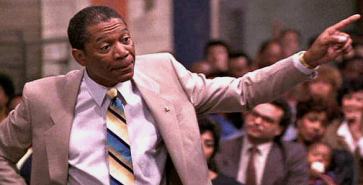
Principal Joe Clark.

'What's that? Becoming a grownup after you've graduated from Georgetown University is scary? WELL MY GOD, GET THIS BOY A BLANKIE AND A THUMB!'

A New Cult Movie: Black Dynamite

Shockingly, Black Dynamite has not yet received its seating assignment in the Halls of Cult Films; it’s also entirely possible that I am not frequenting the right internet forums or attending the right kind of parties. Either way, it is this blog entry’s intent to spread the word about Black Dynamite and get people watching it, but more importantly, talking about it.

Every few years, the Canon of Cult Movies opens its doors to a new entry; that entry then receives the highly-sought honor of being constantly brought up in Internet film forums, quoted at parties, and turned into memes or Halloween costumes.

Shockingly, Black Dynamite has not yet received its seating assignment in the Halls of Cult Films; it’s also entirely possible that I am not frequenting the right internet forums or attending the right kind of parties. Either way, it is this blog entry’s intent to spread the word about Black Dynamite and get people watching it, but more importantly, talking about it and getting OTHER people to watch it.

This. This here is the movie. It's awesome.

The blaxpoitation genre is one that lends itself to parody almost from its inception: while some lauded Hollywood’s attempt to create entertainment aimed solely at a black audience, many within that audience deplored the stereotypical world of pimps, hoes, drug dealers, violence and bitches depicted. For some, it seemed an attempt to create a ‘get out of white guilt free’ card by filmmakers who wanted to reach an African American audience without actually doing anything different.

But whatever its intent, blaxpoitation films have created an indelible mark on American cinema, love it or hate it. In the case of Michael Jai White (best known for his portrayal of Al Simmons in 1997’s apt Spawn adaptation),  who plays Black Dynamite, it’s roundly a labor of love to spoof the genre. Before the film, he regularly held blaxpoitation-viewing parties at his house, and the film was inspired by his listening to James Brown’s Superbad on his iPod.

There is NOTHING to dislike about this film. Although it explores similar territory as 2003’s Undercover Brother, the latter was based on an existing webcomic; in retrospect UB (though I LOVE IT) felt like an attempt to create an Austin Powers analogue for African American audiences. The modern setting severely limited the possibilities for lampooning the blaxpoitation genre, although the film was entertaining enough in its own right.(I’ve seen ‘I’m Gonna Get You Sucka’ but don’t want to get too far off track–this review is more about Black Dynamite than the blaxpoitation-parody microgenre).

Black Dynamite is ALL blaxpoitation: roundly set against the original 70’s backdrop and even utilizing the same crappy stock footage many of those films used, it indicates an encyclopedic knowledge as well as a love of the genre and distills both into a marvelous recreation. Black Dynamite, with its visible boom mikes, mind-blowing dialogue, gratuitous titties, and sinister plot by The Man could have sprung wholly-formed from the afro of Richard Roundtree. But it’s more than that–it’s a brilliant adult comedy the likes of which I thought weren’t even made any more: one that assumes the audience isn’t just in on the joke, but is smart enough to figure the joke out if they aren’t. It offers a sharp, never-slow take for an audience increasingly numbed by dull entries in action and comedy films.

Black Dynamite bids his bitches adieu.

It’s a joke that doesn’t get old for a minute. Each gag is as unpredictable as Black Dynamite himself, and the cavalcade of supporting characters is perfectly cast. There’s not a weak performance to be seen, and some characters like Honeybee leave you wanting much more from them. Even the action scenes, when they aren’t played for laughs, are meticulous–since White has no less than SEVEN black belts in various disciplines he has entirely earned the right to show off. Also, he’s hot.

Although the idea of an action hero being a closet psychopath has been explored to the point of exhaustion, there are a few scenes that get mileage even from that tired old trope, like this one where Dynamite is leaving new girlfriend Gloria in the care of some hoes he looks after.

The whole movie is a treat. From ‘Who the hell is interrupting my kung fu?’ to Roscoe’s Chili and Donuts to ‘First Lady, I’m sorry I pimp-slapped you into that china cabinet,’ there is nothing to dislike. Just remembering scenes I saw two days ago is making me laugh all over again. That and looking up clips, both original and fan-made, on Youtube.

The only weakness of Black Dynamite is that no one is talking about it.  A few more high-profile cameos might have raised its profile a little, and perhaps spending more than 2 weeks in the theater might have drummed up more buzz about it.

I can’t tell you how often I see a comedy that ‘everyone’ agrees is hilarious and I barely crack a smile–I have an odd sense of humor and I also can’t stand comedies where everyone is an asshole; Tropic Thunder made me laugh, Pineapple Express stole two hours of my life and left nothing in me but hate, and the trailer for Hot Tub Time Machine makes me cringe and wonder if John Cusack owes someone money. So when I find a new comedy that actually makes me laugh, it’s a cinch that it’ll entertain even the most dour of viewers.

Watch the trailer (and other goodies!) here.

80’s Vampire Spectacular: My Best Friend is a Vampire

That's just damned good poster design right there.

The next entry in our 80’s Vampire movie Spectacular is My Best Friend is a Vampire, starring  a pre-Dead Poets Robert Sean Leonard, Rene Auberjonois and David Warner. Although it came out after Fright Night, I saw it before FN because Best Friend is rated PG and I believe FN was R. Best Friend is also a little more campy and fun than FN, which made it great sleepover viewing.

Best Friend is about teenager Jeremy, who is nursing a crush on a band geek (who is somehow inexplicably able to blow him off with the same snottiness as if she were Queen of the Cheerleaders) and just trying to survive high school. One day, as he’s going about his job delivering groceries he encounters Nora, the kind of 80’s hot girl that pops up in these movies like high-tops–sultry, alluring, and for some reason interested in sweaty, inexperienced teenage boys. She turns him into a vampire, and wacky hijinks ensue as he tries to figure out exactly WTF is going on. Moments after Jeremy’s deed is done, David Warner enters the scene as psycho vampire killer Leopold, who kills Nora and chases Jeremy from the house.

Enter Rene Auberjonois as Modoc, a super-smooth vampire with a bitching BMW and a cup overflowething with awesome. He’s shown up to help show young Jeremy the ropes and keep him out of trouble. It’s kind of nice if you think about it–sure, it ensures the survival of the vampire species, but it’s also kind of nice to think of an older, experienced vampire out and about, on the prowl for some claret,  and suddenly slamming on the brakes and declaring ‘My NOOB-sense is tingling!’ Then making up a care package of pig’s blood, sunglasses and arty hats.

While Fright Night approached the gay thing obliquely, coding so hard you’d think it was 1990 and the film a LINUX enthusiast, Best Friend hits it head on–Jeremy’s parents observe him hanging around with an older, ‘European’ fellow, driving the fellow’s car with its suggestive ‘NITEMAN’ vanity plate, partying all night and sleeping through the day, and react accordingly for an 80’s parent: they begin reading books on how to talk to their gay son. The entire thing becomes a secondary-story joke, as Jeremy goes about his vampiric adventures battling the vampire killers his parents are often in the background trying to come to terms with the fact that their son probably won’t be producing grandchildren.

There are other literal gay winks, as well: Jeremy, in the throes of bloodlust, visits an all-night butcher and requests a pint of pig’s blood. When the butcher presents it, he winks at the young man and asks if it’s ‘his first time.’ I have no idea what this could be a double-entendre for, but the direct meaning is that the butcher knows all about vampires and is amused by this awkward young man.

Best Friend was also one of the first vampire movies I’d seen that posited that being a vampire wasn’t all that bad: sure, it’s a lifestyle change, but there’s a LOT of good stuff that goes into it. The eternity thing is tempered when Modoc tells Jeremy that for every decade he will age only a year, so there’s still the ‘you get to watch your loved ones grow old and die’ thing, but the rest of the package is awfully alluring. Plus its all a moot point since Jeremy can’t be changed back, unlike in other films where killing the head vampire cures all the ones he’s changed.

There’s a lot to like about Best Friend. Sure, the jokes are sometimes groan-worthy and its fashion hasn’t aged well, but at its heart it’s a story about accepting and even celebrating who you are, even if that is different from the norm. Even now, that’s an awfully positive message: how many films about gay men and women today have to explore their feelings rather than just accept that they are gay? When will we see a mainstream horror or action movie with a gay protagonist that isn’t an allegory or that offers some explanation for the character’s orientation?

Jeremy may hang around with vampires in the future, but he’ll still have time for his human friends. Cheesy? God yes, but cheese makes everything better, even salads.

Best Fiends Forever! Yay Vampires!