Hanging in There Entry: Robin Hood (BBC) Seasons 1 & 2

The show is a fun distraction with some distinctive and moving performances. Heavily anachronistic, it doesn’t take itself too seriously, but does insert lots of little pop culture jokes and references. There is some violence though it’s largely bloodless, and a few characters die. That said, I would say it’s a great family show. The costumes and sets are fun and creative, and some of the jokes really have made me laugh out loud. I would definitely recommend it if you’re looking for something new and fun to get into, but if you’re looking for historical accuracy or accurate arrow physics then you might want to give it a miss.

Slowly, things are improving.

Lately I have been dealing with both getting over a breakup and a death in the family. It’s a lot of normal to be trying to reestablish, all at once, so I am just trying to get through the days lately.

One thing that has cheered me up is the BBC’s Robin Hood. It began in 2006 and only ran for 3 seasons, ending when the principles decided to leave the show. It’s a delightful show though, about friendship and loyalty and love and all those noble qualities that Robin Hood is known for.

Heroism! Derring-do! Costumes!

Hood himself is played by the charismatic Jonas Armstrong, who portrays Robin of Locksley as daring, charming, and even cheeky at times. I’ll say it: I grew up associating Robin Hood with a singing fox, and later with Kevin Costner (I don’t hate Prince of Thieves) and still later with Men in Tights (STILL a classic!). So a brash, cheeky young Robin was a nice addition to the stable of actors who have played the character.

As with all the other canon, Robin and his servant/companion Much (who is an Englishman, I have no idea if he’s canon or not because I’ve never read the Child ballads) are recently returned home from King Richard’s war in the Holy Land. The pair of former soldiers have a strong bond as friends,  and soon find that the old Sheriff of Nottingham has been deposed and a new one installed.

The latter is played with snide, sneering glee by Keith Allen, who I had to look up on Wikipedia but apparently is Theon Greyjoy’s father. He used to do standup comedy at punk shows. How cool is that?

The rest of the gang are here as well: Little John, Alan a Dale, Will Scarlett, and Maid Marian. The latter is a nice departure and far from a damsel in distress: she knows how to fight and is fairly headstrong in the bargain. In fact they could have made her theme music someone shouting ‘DAMMIT MARIAN!’ every time she did something irritating. I didn’t hate the character – far from it! – but just as when you see a smart person you care about make a terrible choice, I was frustrated. Lucy Griffiths was eminently likeable and radiantly beautiful – I saw she was on the pilot for Constantine (which I still haven’t reviewed!) but was replaced by Zed. I think she’s great and she’ll go far, once she finds the right vehicle.

The comedy and lighthearted fare of the show is fun; it’s a family show, I think it ran in the Doctor Who spot, or just after it, and there are far, far worse ways to introduce children to the stories of Robin Hood and his outlaws.

But the show keeps me coming back for this man:

YES HAVE SOME
YES HAVE SOME

Richard Armitage has inspired a HUUUUGE following who call themselves “Armitage’s Army.” I’m not much of a joiner, so instead I’ll tip my hat to the approximately 8 billion fansites and pages of fanfiction they have produced. Well done, ladies and gentlemen! Allow me to congratulate you on your EXQUISITE taste!

I wrote about him before in my review for North and South, and believe me he’s just getting better. 

Gisborne as a character is interesting – he starts out a drawling villain but over the course of the show became such a fan favorite that the writers were struggling to keep him a villain. I haven’t seen the 3rd season yet but I understand that he does sort of team up with the good guys, which he did now and then in the previous seasons. I love tv series for that reason, the character evolution it allows. Somebody can start out a bit player and  a few seasons in steal the show, as happened with Donna Meagle and others on Parks and Rec (I haven’t seen the final season yet! Say nothing!)

The other reason Gisborne fascinates me (besides the obvious) is that I have a thing for his character trope: the damaged ones, the broken ones who imagine that the love of another person is all they need to fix themselves. It is a form of delusion, because in order to be a better person you must first admit that you have no power over someone else and that if you truly loved them, you would let them go and that YOU are responsible for your own happiness. But it’s also the sign of a deeply romantic and sensitive soul – someone who believes so fervently in the power of love that it blinds them to the consequences of their own actions. Of course no other examples of this character type are coming to mind at the moment, but trust me, it used to be a thing I had. For many years I thought I had outgrown it – and then along came Gisborne. When he begs Marian to make a home with him, to stay with him so that his life is bearable, I was totally ready to give him the keys to my house and run down to Uhaul for some boxes to help him move in. I cannot be trusted to make life decisions any larger than ‘yes I would like bacon on my cheeseburger’ right now.

The show is a fun distraction with some distinctive and moving performances. Heavily anachronistic, it doesn’t take itself too seriously, but does insert lots of little pop culture jokes and references. There is some violence though it’s largely bloodless, and a few characters die. That said, I would say it’s a great family show. The costumes and sets are fun and creative, and some of the jokes really have made me laugh out loud. I would definitely recommend it if you’re looking for something new and fun to get into, but if you’re looking for historical accuracy or accurate arrow physics then you might want to give it a miss.

But when it comes to archery be prepared to suspend some serious disbelief.
Shooting! 


And just so you can see how serious I am (although I couldn’t stop giggling while watching this):


The “White Fang” Interpersonal Dynamics Trope

Approximately 900 years ago, when I was in 7th grade, I noticed a book on my parents’ copious bookshelves: White Fang. I really liked the picture of the wolf on the cover, and was kind of going through a ‘everything wolves is AWESOME’ phase, so I read it.

White Fang!
White Fang!

*BREAKDOWN*

White Fang is the story of a half-wolf sled dog, told in 3rd person, during the Klondike gold rush. He is domesticated by Native Americans, then sold to sledders. The process of breaking him as a sled dog is problematic until his owners realize he’s much better at something else – dogfighting. For a time he’s reigning champion, making his owner money hand over fist and becoming a hateful slaughter-machine. He meets his match one day when he is pitted against a bulldog, that clamps onto his throat and wears him down, nearly killing him in the process. A kind man takes him in and heals him, and brings White Fang home to his family, where he very slowly begins the process of re-habituating him to human company, and he learns to trust again. While he is able to adjust to the slower pace of life at the estate, he never becomes a housepet, not really, but his loyalty and affection for his family are unquestioningly proven when he nearly loses his life defending his family against a dangerous escaped criminal.

His story is the kind of overwrought melodrama that 12-year-old me had been waiting to read my whole life. I realize that it is sad to say now, but this book got me through middle school – I was isolated and weird because I had very little in common with my classmates, and became so used to rejection and teasing that I just sort of accepted it and stopped attempting social interaction. I saw the world as combative, and myself as too weak and feeble to have a place in it. But White Fang didn’t give up, so neither did I.

As Abraham Maslow said, “I suppose it is tempting, if the only tool you have is a hammer, to treat everything as if it were a nail.” Taking on a confrontational worldview can certainly help you survive certain situations, but after you’ve escaped them, you must unlearn that ferocity, and readjust to another kind of life. It’s not easy. 

There is a whole story trope that I love, and that I have come to think of as the White Fang trope (it probably already has a name, and if so someone let me know!)  If a samurai or a cowboy is taken in by a village and nursed back to health, if a monster makes friends with a child, I well up like a broken fire hydrant.

And so here is a list of characters who, through various ways and means, were able to hang on to themselves in the midst of the maelstrom and make it through the other side, perhaps to gentler shores. This list is in no particular order, and includes books, films, and graphic novels. It does not include spoilers.

The Hound

 1. Sandor Clegane from the Song of Ice and Fire series by George R. R. Martin.

Patricksponaugle already wrote an incredibly detailed and moving breakdown of why the Hound is so compelling, so go here to read it.

I do want to add a thought though – I started rereading the series over the weekend and was struck by two things I had forgotten:

  • Nobody knows the story of how the Hound’s face was burned until he tells Sansa Stark. She is literally the first person he has ever opened up to about what happened to him as a child. Granted, the way he opened up to her was, like everything else about him, brutal and rough. But hammer, nails, etc. I can’t imagine his communication vocabulary would be very large after the way he grew up. Not excusing him, just trying to understand.
  • The Hound winning the tourney was the first time a crowd had cheered for him. He threw down on his brother and saved Loras Tyrell, and for the first time in his life, he got to be the hero. It seems to have made an impact.

It seems the Hound is trying to learn something new. Dog, tricks, etc.

Experiment 626!
Experiment 626!

2. Stitch/Toothless

Lilo and Stitch and How to Train Your Dragon  I’m including as a double entry, since they were the brainchildren of the same man and explore very similar themes: of societal expectations and pressures, of nontraditional families, of the bond that forms between a lonely person and their pet [and it is deliciously ironic that JUST AS I TYPED THAT SENTENCE, my 16-lb cat tried to jump into my lap, missed, hooked his claws into the flesh of my upper thigh and hung there, mewing pitifully].

In both films, two isolated individuals become friends after taking a risk: Lilo and Stitch, and Hiccup and Toothless. There is a moment in How to Train Your Dragon that I WISH I could find in gif form: it’s when Hiccup puts his hand out to touch Toothless on the head, and the dragon leans forward to be petted–but there’s a hesitation first. The animators REALLY outdid themselves with that performance; so much characterization was put into that little gesture and it was perfect.

See that mustache? That was ALL Kilmer. No weaves or glue there!

3. Doc Holliday 

Doc Holliday’s portrayal in Tombstone is one of my favorite characters. EVER. The real Doc Holliday was a wonderfully complex man, a professional dentist, gambler, and gunfighter who moved to the west in the hopes the dry climate would be good for his tuberculosis.

When he first appeared onscreen, everything about him screams ‘I AM TROUBLE. EXIT THE VICINITY AND SAVE  YOURSELF.’ He’s effete, and while he’s funny and charming as hell, his predilection for starting fights around himself was a major drawback to being his friend. Or even being his tablemate in a poker game. He’s condescending, he’s arrogant, and yet Wyatt Earp always considered him a friend.

Holliday is a strange, strange man, but he was always unquestioningly Wyatt’s friend as well. Which is why the most powerful moment in a film FULL of powerful moments is when Wyatt invites Doc to sit out a fight that could get him killed, basically telling him ‘I don’t expect you to follow me into this mess I’ve made for myself.‘ And Doc just looks at him and responds with, “Well, that is a hell of a thing for you to say to me.”

Beautiful. 

Doc Holliday’s only companion, a whore, is with him because of the money he nets her at the poker table. He has no other people who care for him, who would give a toss whether he lives or dies than Wyatt Earp. So of course he would follow Wyatt into the fire if he had to.

Not listening! Not listening!

4. Smeagol

Personally I always take care to differentiate over who I am talking about: Smeagol or Gollum. It just depends on who’s in the driving seat. Granted, to focus on the positive side of the character is to downplay the terrible power of the other, and ultimately that other side won out. But I’ve always thought that Frodo really got through to Smeagol, and reached something inside him that hadn’t been alive in a very, very long time. Smeagol is widely interpreted by many, as an addict, as a sufferer of various mental illnesses, but all agree that he is trapped by his obsession with The One Ring. Ultimately his selfish and false “love” for this object destroys him, but saves Middle Earth.

Smeagol doesn’t quite fit on the list since this list is about characters who take that leap of trust to another person, but in a strange way he does, since it’s just as important to see what happens when the leap falters.

There are so many other characters I could talk about, but I will end things here. Have you noticed a pattern like this one in films? What kind of films are YOUR favorites?


New Cult Classics: Tucker and Dale Vs. Evil

I can totally laugh at jokes that poke gentle fun at Southern people, because if you can’t laugh at yourself you’re probably taking yourself too seriously. Southern people are dramatic, we indulge in family squabbles, we have crazy-ass relatives who are always setting themselves on fire or outrunning The Law or some other thing that you might see on COPS. I fully acknowledge this, and I embrace my heritage. But, as Jesse Custer himself said, “You don’t start raping tourists because you had grits for breakfast.”

Tucker-and-dale-vs-evilI had no idea what I was in for when I hit “play” on Tucker and Dale. I  heard good things, but nothing detailed. And as with many films I take a gamble on, I figured I could just shut it off if I didn’t care for it.

I figured it would be yet another tale of clean-cut, All-American youth taking a wrong turn and encountering inbred, cannibalistic, rapacious hillfolk mutants. And the movie certainly sets up that that is what’s going to happen: we are quickly introduced to a car-full of privileged young College Kids on holiday, passing some reefer around, and the girls are appropriately scantily clad.

But before I got much farther, let me explain something.

Growing up a Southern person, you hear jokes. My mother is from a small town in South Georgia, and my father was born in West Virginia and moved to Florida at a young age. Never mind that West Virginia was actually part of the Union, and, you know, the whole state was created because the inhabitants were Pro-Union – most Americans don’t know or care about that, and I’ve heard more than my share of ‘Ha ha, Southern people are inbred and live in trailers and swamps and rape tourists!’ unjokes.

That said, I can totally laugh at jokes that poke gentle fun at Southern people, because if you can’t laugh at yourself you’re probably taking yourself too seriously. Southern people are dramatic, we indulge in family squabbles, we have crazy-ass relatives who are always setting themselves on fire or outrunning The Law or some other thing that you might see on COPS. I fully acknowledge this, and I embrace my heritage. But, as Jesse Custer himself said, “You don’t start raping tourists because you had grits for breakfast.”

And as I was delighted to find, the College Kids are not the protagonists; Tucker and Dale are.

The setup starts to unravel when College Kids realize they forgot the beer, and stop by a gas station to stock up. The gas station is appropriately derelict and filled with rusty farm implements and animal parts, and some local weirdos are lurking nearby.

After an unnerving encounter with some of the dingy local color, the story begins following these two-the eponymous Tucker and Dale- and everything becomes a lot more interesting. Tucker and Dale have recently purchased a “vacation cabin,” (played by a Backwoods Murder Shack Style #4) where they are looking forward to some drankin’, fishin’, and relaxin’.

YAAAAAAAHHHH!!!
YAAAAAAAHHHH!!!

They set to fishin’ and drankin’ that night, but the relaxin’ part gets screwed when they see one of the College Girls take a nasty fall as she attempts to go skinny dipping. They row over to save her and find she’s unconscious. Naturally, when the the other College Kids witness Tucker and Dale dragging her limp, naked body into their skiff, they assume the worst.

The rest of the film is a series of unfortunate events that seem to mercilessly incriminate our hapless heroes. It’s a hilarious takedown of the genre, and I won’t spoil it by going on too much further. But the bees and chainsaw moment is just magical!

Fans of NBC’s 30Rock will recognize Katrina Bowden, who played vapid and ridiculously hot intern Cerie. When I saw her name in the credits I thought ‘oh, they found a hot girl, that’s nice’ and I totally ate my words: she has great comedic talent and plays the highly likeable heroine, Allison. I think she has a great shot a comedy, and I hope she gets a chance to show off that talent more.

The movie has a 7.6 on IMDB, and is highly rated on Netflix. If you’re a fan of deconstructive, intelligent horror comedy like Cabin in the Woods, or Shawn of the Dead, you will definitely like this movie. I can’t say it’s as great as those and has nowhere near the production value, but it definitely belongs in their company for the writing and characters alone.

Check it out!

A Magical Modern Fairy Tale: Penelope (2006)

I have to say how much I like Dinklage in this film. His character has an interesting arc, for one thing: since he’s never seen Penelope, he only has secondhand accounts to go by. When he finally sees her picture, he’s astounded by how very UN-monstrous she is, or that she could think of herself as such at all. There’s a connection there; he, as a little person, has to field curiosity and attention about his appearance wherever he goes. If this were a different kind of movie, he might have a moment of resentment. After all, Penelope had the benefit of a VERY wealthy upbringing where she was able to control her surroundings entirely. He has a job, and no walls between himself and others. He has nowhere to hide. But this film is definitely light entertainment, so rather than resentment, he regrets the story he tried to make out of her appearance.

Christina Ricci stars as the titular pig-snouted Penelope.

Penelope is a rare hidden gem. It’s quickly become one of my new favorite movies, and there are many reasons why. It has an AMAZING cast: headlining it are Christina Ricci, James McAvoy, Catherine O’Hara, Peter Dinklage (!!!), Richard E. Grant, and Simon Woods (who I recognized as Augustus Caesar from HBO’S Rome). And then there are the supporting cast: Reese Witherspoon, Nick Frost, Burn Gorman (WHO is that guy’s agent? he’s in everything lately!). The art direction is reminiscent of Amelie, as everything is colorful, whimsical, and beautiful. I’d like to just disappear into the wardrobe closet with a shopping cart and redo my life with everything that everyone wore.

The story is very light; it’s a modern fairytale about a wealthy family whose pride caused a witch to place a curse on them: their daughter would give birth to a monstrosity. Naturally the family had about ten generations of sons, but finally a girl was born, who was in every other way perfect except for her little piggy nose. Until the girl is loved by one of her own, she’ll bear the pig nose for the rest of her days. Penelope’s mother makes it her life’s mission to break the curse, hiring a full-time husband finder to try and pair Penelope with any blueblood who’ll have her. Hundreds of likely suitors scream in horror and dash off at first sight of here, and herein is one of the movie’s biggest failings.

It was just hard to believe that not only were these guys unable to get past the snout thing, but that they ran in HORROR from her. There’s so much else going on! She’s gorgeous! That SKIN! The shoes! THE GIANT PILE OF MONEY THAT COMES WITH HER FAMILY NAME. But the film is making a point about superficiality, so there’s that.

Simon Woods’ character, Edward, is the latest in a long line of matchmaking failures, and his rantings about a hideous pig monster catch the ear of Peter Dinklage’s character, Lemon. Lemon is a reporter who lost his eye trying to catch a picture of the infamous pig-nosed baby years before, and has been trying to get material for a story on her ever since.

I have to say how much I like Dinklage in this film. His character has an interesting arc, for one thing: since he’s never seen Penelope, he only has secondhand accounts to go by. When he finally sees her picture, he’s astounded by how very UN-monstrous she is, or that she could think of herself as such at all. There’s a connection there; he, as a little person, has to field curiosity and attention about his appearance wherever he goes. If this were a different kind of movie, he might have a moment of resentment. After all, Penelope had the benefit of a VERY wealthy upbringing where she was able to control her surroundings entirely. He has a job, and no walls between himself and others. He has nowhere to hide. But this film is definitely light entertainment, so rather than resentment, he regrets the story he tried to make out of her appearance.

[excited noises]
  At long last, a guy appears on the horizon that captures Penelope’s interest, and doesn’t seem put off by her situation. James McAvoy plays the impossibly handsome, self-effacing, and down-to-earth gambler that Edward and Lemon set up as a possible match for Penelope, and hide a camera in his jacket so he can get a shot of her. Of course he finds her fascinating instead, and when she finally does appear he’s less horrified than saddened by the fact that he can’t be involved with her as he’s not really a blueblood.

I also have to admit that I forgot how good-looking James McAvoy is – the movie I most associate him with is The Lion, The Witch, and the Wardrobe, where the shoe was on the other foot and he played Mr. Tumnus the faun, complete with hooves, horns, and a goat nose. In Penelope he’s totally the guy you thought you’d fall for in college: he has a cool, Flashdance-y loft, plays piano, and wears engineer boots and cool hats while being self-effacing and kind. Of course he’s tough and hardened on the outside but has a warm gooey center, but that’s the kind of character this type of movie would need.

Penelope has its drawbacks: an odd, rambling plot that is more challenging than the usual rom-com stuff is the most noticeable thing; a definite disconnect from reality in that all the sets and wardrobe are absolutely beautiful and luxe; sometimes unsubtle performances (Simon Woods doing comedy is a treat, after his icy performance in Rome).

But it’s definitely worth seeing. It’s message–that you must love and accept yourself most of all– is the strongest thing it has going for it, and I kind of wish they’d show movies like this instead of ‘This is what happens to your body’ in 5th grade. Ricci’s performance is delightful, and she looks absolutely radiant the whole time, even with the pig nose. All the British actors do American accents for some reason, and Richard E. Grant’s American accent is a TREAT. And as I mentioned, every inch of the film has been created to look beautiful, so it’s a lot of lovely eyecandy as well.

Penelope is available on Instant Watch.


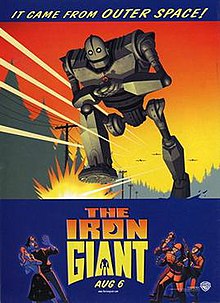
Additional Thoughts: The Iron Giant

I think one of the most poignant scenes of this movie is the moment we finally get to see humanity from the Giant’s perspective: after Hogarth tells him that the bomb will kill everyone, he looks down at all the little people scattered on the ground before him, and at the shops and buildings no bigger than snackboxes. With a few strides of his legs he would be free of the blast radius, or he could simply fly away. It’s just a little place on a world he isn’t from, and he doesn’t have to be a part of its problems at all.

Here is the original write-up that I did of the Iron Giant a few years ago.

Brought to you in Fan-TAST-A-Vision!

Last night I watched it again and had a few additional thoughts that I wanted to get down.

1. The Post-War Setting

Hogarth’s father has been killed in action, that much we can get from subtle hints through the movie:

  • Hogarth’s Mom is having financial difficulties and works as a waitress, renting out the room in their large house.
  • There’s a photo of a man climbing into a vehicle cockpit on Hogarth’s bedside table
  • One of the pictures that Mansley develops from Hogarth’s camera is of both Hogarth and his mom, begging the question, who took the picture? I’m guessing his Dad, before he went away
  • Annie calls Dean “sweetie” at the movie’s end and has clearly developed a relationship with him, indicating Hogarth’s dad is permanently out of the picture (unless Annie is rocking some seriously progressive relationship dynamics).

But there was something I noticed about twenty minutes in. I had absorbed it but never really thought about the other people in the town – it’s almost all women, kids, and older men. And I realized that it’s because all the younger men were called up for service in the war. And more than likely, didn’t come back. If that’s something intentional on the part of the filmmakers, then BRA-VO. That is a beautifully subtle reality of post-war life.

If this is accurate, then it also adds another layer of subtlety to Dean and Mansley’s characters – Dean might be a conscientious objector; the way the other men in the diner sort of dismiss him could just be because of his beatnik stylings, but it could also  be that he’s thought of as a “draft dodger.” And Mansley was left behind because he’s just plain incompetent.

2. Hogarth’s Reaction to Death 


OUCH!

Hogarth is a sensitive, intelligent, and creative boy. He saves the Giant when the latter is endangered at the power station. When the Giant destroys the traintracks, he is horrified at what could happen. When he and the Giant encounter the deer and the hunters, he gently tries to describe what happened to the deer, and is incensed when the Giant tries to pick the body up.

Additionally, he has a serious talk with the Giant about souls and what happens when you die. He quotes his mother’s belief in souls, and I imagined his mother having this discussion with him after his father passed away. It’s a terrible thing, to bury a loved one, and he doesn’t want anyone to experience what he went through, especially not at his expense.

3. Hogarth As Father Figure

Hogarth finds this creature, takes him in, and extends hospitality to him. He helps him find food, and a safe place to stay. He becomes the Giant’s protector, in a lovely role reversal. It’s not every ‘boy’s movie’ where the main character is a protector or nurturer. At very few times during the movie is Hogarth in danger – it’s the Giant who is in the most danger. At the end, Hogarth again saves the Giant by arguing with the General that he is not dangerous, although Mansley borks that plan by grabbing the telecom and commanding the Nautilus to fire its atomic weapon. The boy and Giant are literally following the roles of Jonathan Kent and Superman, and just as in that story, the child (Giant) matures and assumes the role of protector.

I think one of the most poignant scenes of this movie is the moment we finally get to see humanity from the Giant’s perspective: after Hogarth tells him that the bomb will kill everyone, he looks down at all the little people scattered on the ground before him, and at the shops and buildings no bigger than snackboxes. With a few strides of his legs he would be free of the blast radius, or he could simply fly away. It’s just a little place on a world he isn’t from, and he doesn’t have to be a part of its problems at all.

The Giant is destroyed in his role as protector, but as we see at the end of the film, he isn’t really gone. He’ll be back, and OMG I get emotional just WRITING about it. And Hogarth has a father figure again, both in Dean, and in the Giant, who’ll be returning soon.

4. Giant as Russia

Obviously, the film’s big themes are the Atomic Age and beginning of the Cold War. Dean literally tells the General that the Giant “will not attack unless he’s attacked first,” which was the entire situation of the Cold War. There’s even a joke about the Giant not wanting to be Atomo, the atomic robot villain.

Additionally, the fear and hatred whipped up in the townspeople by Mansley is also ephemeral once they realize the Giant poses no threat, and is even as invested in peace as they are. And, just as in nuclear holocaust, when you’re about to die the lines between hero and villain kind of fall away, since there’s no time left for such distinctions.

So those are the thoughts I thunk while watching it again last night. I do love a good, layered film that makes you think, and that you can see differently if you go back to it.

I hope you’re having a great day! If you haven’t checked this movie out, you might. It’s not on Instant at the moment but it’s widely available elsewhere.

Just, you know, maybe bring some tissues!