Arbitrary List! Entry: The Five Best Deaths from HBO’s ‘Rome’

I was recently rewatching my all-time most favorite TV show, HBO’s Rome, and realized I had a perfect opportunity for a blog entry. Unfortunately, Rome is not available on Instant and by all accounts may not be for a long time; HBO offers its own streaming for its content, so we won’t see its programming streamed anywhere but the HBO site anytime soon. So you can only get it on DVD.

It kind of goes without saying that there will be spoilers in this entry; I mean, if you haven’t watched the show and don’t want anything spoiled then perhaps you should give today’s entry a miss. On the other hand, if you are able to read English at all and are surprised to find Julius Caeasar to be a character who dies, then I congratulate you on your ability to filter information at such an astounding rate.

5. Vercingetorix, King of the Gauls

Vercingetorix’s death itself, a gruesome strangling, is not so interesting as what it signified.

When first we meet Vercingetorix, he has been defeated in battle by Julius Caesar, and is being ceremoniously stripped of his clothing and crown (a pretty bitching little number with pheasant feathers on it). A tall, striking man, he is forced to kneel and kiss Caesar’s standard as a sign of submission, and is then thrown in the dungeon.

There he stays for most of the first season, until he’s taken off the shelf and presented to Caesar one day, who offers a chilling ‘Goodbye, old friend,’ before instructing his minions to clean up the now-decrepit, broken man. As was made clear in the Princess Bride, you should be healthy (or at least look it) before you are broken.

Which is ironic, as he is being trotted out in order to be executed in front of the ravening crowd at Caesar’s triumph.

In the history of Public Relations, the Romans were goddamn rocket scientists. They knew better than anyone before or after (except the Nazis) of the power of perception over rational thought. Show a once-powerful person broken, in the right context, and the might of Rome doesn’t just become an idea to the people, it becomes sacrosanct. ‘THIS is what the power of Rome can do,’ such an event demonstrates. ‘Serve Rome, or fall.’ It’s perfectly illustrated by how the people cheer after Vercingetorix is strangled to death, and how his mouldering corpse is considered just another piece of decoration to be swept up, afterwards. Never mind what it signified to the other side (the decimation of the Celts and Gauls, and how Rome would now become rich beyond measure as a result of the massive gold reserves of Gaul and Britain); for the average Roman citizen, it was just so much confirmation that they were on the winning team.

4. Eirene

Being dragged behind a wagon is an excellent exfoliant. Look at that skin!

 Eirene’s death was startling not just because of how surprising it was, but because it seemed unnecessary.

In a historical show where people are dying left and right, it seems almost unfair that a character who falls in the ‘not really based on anyone specific but more a composite of other people and is just kind of a fun side character’ group should die. Especially given the circumstances: while pregnant with Pullo’s baby, she is poisoned by a jealous Gaia. But the abortifacient seems to go awry, and Eirene dies, instead of just miscarrying (or maybe that was Gaia’s intent all along; then again, the apothecary seemed assured that the potion would be fairly straightforward).

I liked Eirene, although she didn’t have much to do, storywise. She functioned as a vehicle to show that Pullo was capable of gentleness instead of just violence, but that character trait came out anyway, through his interaction with the children. And Pullo as a doting father was a lovely counterpoint to the darker goings-on of the show. But Eirene as a character was kind of quietly awesome- she was strong, hardworking, and inpatient with slaves who did not know their place or did not work as hard as they should have. This last is because she herself was a slave; along with that comes all kind of complicated character building. She holds other slaves to her own high standard–or perhaps takes a special small joy in being the one doling out beatings.

3. Julius Caesar

He would make a great Vulcan, admit it
"Can't wait to get home and kick back with my boy, Brutus!"

Caesar’s death is kind of a given that it would be on this list; after all, it’s the penultimate moment of the first season, and sets into motion almost all of the events of the second.

The event itself is ugly, and brutal. It probably also wasn’t clean or short enough, if you ask Caesar himself: a veteran of many wars, he probably knew how to kill a man more efficiently than the indolent, privileged members of the Senate who did him in. Additionally, what appears to be an epileptic attack occurs, which both prevents him from properly defending himself and reveals his condition to the whole of the senate. His last act is an attempt to hide his contorting face, as Brutus looks on in horror.

I’m sure the Liberatores (as they are historically known) thought they were doing Rome a favor, but considering the chaos that ensues in the wake of Caesar’s death, it’s clear he proved a very stabilizing force, both politically for the city, and personally for its inhabitants. Historians still fume and foam over this murder; was he a tyrant, or a visionary with Rome’s best interests at heart? Unless a secret diary is unearthed in which he declares himself God and discloses his plans to personally molest and murder every inhabitant of Rome, we’ll never know.

2. Marc Antony

"OMG im so hi lol!!!"
"What? I can't, I don't even. . . is that a boob hubcab?"

Somewhere in the depths of freshman level Psychology, I learned that while women are twice as likely to attempt suicide, men are five times more likely to succeed. My data may be skewed, but the logic is this: Women are more likely to make suicidal gestures, like cutting and pills, but men tend to choose more final methods, like blowing their heads off with shotguns, or throwing themselves off cliffs. This could also be complete bullshit, but it’s oen of those little interesting facts I filed away.

When Antony decides to off himself, it is after a long downward spiral of drugs and debauchery. Guilt-ridden over Caesar’s death, he makes a series of political missteps (and a few small victories) that eventually land him in Egypt, presiding over a court of sycophants and whores. He goes native, declaring himself the god Osiris to Cleopatra’s Isis, gets a boss snake tattoo, and decks himself out in the latest in celebritry Egyptian fashion, which looks kind of like something Liberace’s pool boy might have deemed ‘too much.’

Antony’s death was as much a character death as a theme death. The show afterwards felt less like a denouement than a few loose ends being tidied up, as nothing that occurs afterwards seems as important or interesting. Sure, Cleopatra had her big moment, and Lucieus Vorenus and Pullo had their wrap-up, but it felt a little tacked on. Antony killing himself, with Vorenus’s help, was the end of both the Caesare story arc and the direction of the show. It’s almost a shame it wasn’t the last, last minute of the show, as it would have been easier to accept the show’s cancellation, then. Showing us Octavian’s triumph and everything else that occurred jsut reminds we, the viewer, of everything that we WON’T get to see.

1. Cicero

EARS!
"I believe I shall go home and stupify myself with wine." -Actual quote from the show

You’re surprised, aren’t you?

Certainly, many characters had more exciting deaths than Cicero, but his was the most poignant to me.

Perhaps it was because Cicero, while a Patrician, was not as established within that class as other highborn Roman characters, and it always felt as if he were eternally chasing that brass ring, all the while struggling to maintain a moral center. Cicero had to work hard to get where he did. He isn’t courageous by his own admission, but still manages to stand up for what he believes in when he declares Antony a ‘wreck.’

Cicero’s death, when it comes, is a strange peak in the show. The pacing slows down a great deal; he observes a single bird overhead, and seems to be reflecting on not how little he has done with his life, but that it should end this way, in his garden, while his slave weeps hysterically in the background. The sun is bright and a soft wind is blowing, rustling the leaves of his peach tree. It’s a beautiful day, the rest of which he will not see.

Cicero’s resignation to his fate is only part of the greatness of this scene; the other half is Titus Pullo’s gentle, self-assured assistance as he helps walk Cicero through his last moments. He asks permission to take peaches from Cicero’s garden. It’s clear that Cicero is thinking of other, much loftier concepts, but the import of this small concession is not lost on him. In five minutes, they won’t belong to anyone, after all, and Pullo could do as he likes. He’s no mindless thug, come to humiliate Cicero, loot his house and commit violent murder; he’s simply carrying out orders.

The other interesting thing about this scene is its small flirtation with the concept of mortality. Cicero mentions that he will be immortalized in all the history books, and so will his killer. Pullo mistakenly takes this to mean that he will be immortalized, physically, before the matter is cleared up. Their names and deeds will live on, if nothing else.

Rome is a show I include in a group filed under ‘Great Humanist Dramas.’ Sure, many of the characters invoke the names of their gods as they go about their business, occasionally even putting importance into that god’s opinion of their actions, but ultimately it’s a show about humans.
Ultimate Children’s Movies: The Iron Giant

Iron Giant is set during the height of the Red Scare in the 50’s, when the U.S. is bitter over the success of Sputnik and the Russian space program, and paranoia is everywhere. Suddenly the world was much smaller, and there was much less elbow room for the bigger countries, and worrying too much about what your neighbor (on a global and personal scale) was doing was just what folks did.

“You are who you choose to be.”

The Iron Giant is one of my favorite movies, easily. And yet I didn’t see it until about  a year ago, probably for the same reason a lot of people missed it–the marketing campaign.

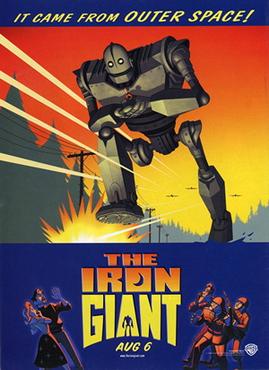
Here’s the imagery of the original ad campaign:

Seriously–great retro design, but definitely leaves a ‘stuff blows up!’ taste in your mouth.

It’s a great design–the retro styling has the 50’s sci-fi movie poster artwork down pat, and even directly quotes it with that most seminal of 50’s sci fi movies, It Came From Outer Space.

With the excitement of the action shot, and the robot dodging tracers from fighter jets, its easy to miss what he’s actually doing–he’s carrying Hogarth, the film’s human protagonist, as he runs for his life. The white lines made by the tracers draw your eye to the giant, but its easy to miss Hogarth clutched in his hands on a fast glance. This image is really the heart of the whole movie.

Here’s the recent dvd release cover art:

It Came From Outer Space to Learn Stuff About Having a Moral Compass
Thoughtful, much more slower-paced, lots of blues and greens

Very different, No? Leads you to memories of ‘E.T.: The Extraterrestrial,’ which is a much more apt comparison for this movie. Imagine if E.T. had been fifty feet tall, was a deadly walking weapon, and had the mind of a child.

Which is a shame, because what the filmmakers had on their hands (and probably knew it) was the E.T. for the Internet generation.

I may be biased because I am a huge fan of the film’s central message of personal accountability — the giant has been constructed as a weapon, a conquerer of worlds, but when he crash-lands on earth his memory is reset and he has amnesia. Enter Hogarth, an imaginative loner and only child, who finds the Giant and after a few bumps, becomes friends with him. Hogarth teaches the Giant that he is not what he is made to be, but rather, he is who he chooses to be.

I am a huge fan of personal accountability, in life. I think it’s up to every person to be the best person they can be, to try. The reason is because through that continual process of self-improvement, a person will find things out about themselves that they may have never known otherwise. How can you know your limits if you don’t push them? How can you know what tempts you if you’ve never known temptation? I guess I am making a big positive assumption about my fellow man–after all, a lot of people are capable of doing quite horrible things, but the point of all this is knowing yourself so that you know what harm you are capable of doing to others, and then not doing it. I know it’s convoluted, but it’s simple once you get down to the bare bones of it–Know Thyself. Just like the Greeks had over the doorway of the temple at Delphi, it is your responsibility to know yourself and be responsible for yourself, to take ownership of both your flaws and your good qualities.

This philosophy is also illustrated by the Giant himself–he’s 50 feet tall, and can do some SERIOUS damage if so motivated, or even if he’s just talking a walk. If he isn’t aware of his own movements he could easily crush Hogarth, or someone else, or even wipe out the whole town.When his weapons array is triggered later on, you see how easily he could dominate the whole earth, or worse, how a small force of Iron Giants could do the same.

Iron Giant is set during the height of the Red Scare in the 50’s, when the U.S. is bitter over the success of Sputnik and the Russian space program, and paranoia is everywhere. Suddenly the world was much smaller, and there was much less elbow room for the bigger countries, and worrying too much about what your neighbor (on a global and personal scale) was doing was just what folks did.

One wrong move, and a splat, a weird smell, and no more Hogarth.

Another great thing about the film are the supporting characters – a grab bag of 50’s tropes that could have been really shallow and one-dimensional, but who were so well-written that they really are worth a second look. There’s Hogarth’s mom, a single mother and waitress; Dean, the local beatnik scrap metal-artist (voiced by Harry Connick, Jr. in a really nuanced and great performance); even Kent Mansley, a pain in the ass G-man out to expose the giant and destroy it is well-fleshed out. He’s a man with ambition but no morals or concern about others or the ramifications of his own actions, and is essentially the polar opposite of the giant. Even General Rogard, a second-string character has unusual depth–aware of his responsibilities to the WHOLE nation, he must consider the potential risk in the idea of destroying a town of Americans in order to destroy the giant, and finds the idea horrifying and distasteful.I liked how the military wasn’t shown to be a bunch of single-minded drones; even though this film came out on the heels of the 90’s, when government plots were usually hand in hand with Sci-fi, based on the success of the X-Files.

What’s additionally interesting about Iron Giant are the questions that aren’t answered–and really, it’s a stronger story that way. It doesn’t matter, after all, it’s what he chooses to be that is the point.

Any way you slice it, Iron Giant is an instant classic, to borrow a phrase that has been overused to the point of cheapening its meaning–the movie really is a spectacular film for children, although maybe not very young children, given a few scary, intense moments. It’s literally a movie for all ages, since even at 32 years old I found it wonderfully intelligent, moving, and exciting at once.

Additionally, it was directed by Brad Bird, the genius behind The Incredibles and Up, and used to be involved with the Simpsons. Vin Diesel voices the giant (this was just as he was hitting it big), and there are a host of recognizable voices in the background of the story, all lending considerable weight to what oculd have been throw-away characters.

The Iron Giant is available on Instant Watch. You should go watch it RIGHT NOW.

Great Moments in Humanism Entry: Groundhog Day

A movie like this is bittersweet, because while it enriches the viewer, I can think of countless people who would benefit from the kind of psychological ‘time out’ that Phil experiences. Because that’s what it is – someone basically said ‘You sit in this corner and think about what you’ve done,’ except on a cosmic scale.

Phil Connors: What would you do if you were stuck in one place and every day was exactly the same, and nothing that you did mattered?

Ralph: That about sums it up for me.

Seriously. This is amazing.

Groundhog Day.

You’ve seen it or, or you haven’t, or you’ve seen it, and wondered what all the fuss was about.

Or you’ve seen it, and you know exactly where I’m going.

Harold Ramis’s 1993 film Groundhog Day stars Bill Murray as egocentric megabastard Phil Connors, a cynical weather man with disdain for only the whole of creation, who is trapped in a strange time flux and relives the same day over and over again.

The premise sounds corny, and when I first saw the movie at age 12 or so I wondered what the hell was going on with it. But it stuck with me. It’s like bookmarking a page that has a word you don’t understand and mean to look up, and then years later you either understand the word or have enough experience under your belt that you can figure out what it means. I love things like that. . . that you need to mature in order to understand.

Newsman Phil has to go to Punxatawney Pennsylvania to report on the verdict of Punxatawney Phil, the most famous groundhog in the US, on whether or not to expect more spring or winter. Each day is begun with the alarm clock playing Sonny and Cher’s ‘I got you, babe,’ and at first Phil makes the most of his situation–since everything happens the same way every day, through observation he is able to later manipulate situations to his own advantage, and uses this knowledge to rob banks, romance women, eat horribly, and generally sate his most base appetites. When he realizes the one thing he wants that he can’t have is Rita, he embarks on a journey of never-ending self-destruction: despondent about being trapped forever in a small town with no consequences to his actions, he throws himself off buildings and crashes cars or steps in front of trucks in the hopes of killing himself and escaping the hell that is a never-ending Groundhog Day.

Get used to this image.

Groundhog Day was incredibly underrated when it came out–which is a shame, because it’s much smarter than the average crappy romance comedy/fantasy. There’s a key line that ties the whole movie perfectly together.

While attempting to romance the unwilling object of his affection, Rita, played by Andie MacDowell, Phil screws up and draws her ire. She slaps him and asks if the whole day has been some some big ploy to get her to love him. He responds with the incredibly apt: ‘But I don’t even like myself.’

That’s the key part of the whole movie–Phil’s cynicism and misery springs from the fact that he really, truly hates himself, and therefore everything and everyone else in the world.

Here’s the interesting part, where the movie goes from a goofy romance-comedy to a brilliant character study; we get to see Phil really grow and change as a person. He starts out a childish, selfish douchebag, belittling anyone who shows him kindness and dismissing kind people as weak. As he begins to manipulate situations to his advantage, thus getting anything he wants, he realizes that this is boring. He attempts to woo Rita, meticulously researching her likes and dislikes and trying desperately to synthesize a personality that she finds attractive: studying French poetry, memorizing her favorite things, and asking her endless questions to get to know her better. Alas, she sees through his attempts for what they are: a facile attempt to fool her into liking him.

He really does play in real life, I think.

After she drops him, his despondence leads to the aforementioned many suicide attempts. He is truly, truly miserable now, in a hell of his own making.

Since being a selfish bastard didn’t make him happy, he  decides to try going in the opposite direction: he becomes the town’s worker of small miracles, changing tires for old ladies, helping the helpless, etc.  His crusade of selflessness includes trying to save an elderly homeless man from death, and here he really begins to evince the change: unable to save the man, he finally begins to understand what caring for others is.

Since he seems to have unlimited time, he learns the piano and reads classical literature, teaches himself too cook and other tasks he might have overlooked or been uninterested in previously.  This intellectual banquet leads him to further realize how petty and mean he was before this strange phenomena happened to him, and his bad attitude is tempered and reshaped over the small eternity he spends on Groundhog Day.

A movie like this is bittersweet, because while it enriches the viewer, I can think of countless people who would benefit from the kind of psychological ‘time out’ that Phil experiences. Because that’s what it is  – someone basically said ‘You sit in this corner and think about what you’ve done,’ except on a cosmic scale.

It’s only when Connors learns to love himself, and by extension other people, that he is able to escape from Groundhog Day.

I like Groundhog Day because it imagines that even the most cold-hearted bastard is capable of change, given the right amount of time and right circumstances. Murray is the perfect person for this role, since he knows how to portray someone both cynical and warm: after all, cynics are usually people whose soft hearts were broken early in life, and grow callous and cold in an attempt to prevent it from ever happening again. Having been a cynic and grown up around them, I know exactly what I’m talking about. Murray probably knows that or experienced it in some form himself, since he illustrates it so beautifully in his characters. Sure, he doesn’t have the world’s widest range, but he has what he does down to a science.

Groundhog Day is available on Instant Watch.


Horror Movie Month! Th13teen Ghosts

I can kind of see why Thirteen Ghosts didn’t catch on with its intended audience; it’s one of those horror movies that’s smarter than the ads presented it, but the excess of effects and ‘ACTION!’ tone to the marketing turned off the smarter audience who would have enjoyed it. Its writing and story reminds me strongly of the Hellblazer graphic novels, which were made into the film Constantine, and which had very little to do with the source material. But I digress.

In 2001, the Dark Castle production house was looking for another remake of a Vincent Price movie, and they found it in the strange, weirdly fun Thirteen Ghosts. I haven’t seen the original Thirteen Ghosts

BIG Scary Face!

The resulting film is strange for a horror movie–it’s almost like a brilliant experiment gone wrong.

The action starts with F. Murray Abraham (I know, right?) and Matthew Lilliard attempting to capture the ghost of a mass murderer who haunts the junkyard where he buried his victims. Lilliard plays Dennis Rafkin, a man with strong psychic abilities who has been contracted b Cyrus Kritikos (Abraham) to help locate and capture ‘displaced spiritual energies.’ He doesn’t much care what the ghosts are being captured for, but when he realizes that the ghost they are hunting was a much more prolific murderer than they’d previously surmised, he’s horrified and almost walks away from the whole project. Also introduced are the methods by which Kritikos captures ghosts, a mixture of steampunkish technology and broadcasting chanted spells over loudspeakers, which somehow forces the ghost into a large glass cage. Also introduced is Kalina Oretzia, a sort of freedom fighter for ghost rights who has a problem with Kritikos capturing and enslaving ghosts. Oretzia is played by the beautiful Embeth Davitz, alumni of Army of Darkness and also, weirdly, Matilda.

Things Go Wrong, Kritikos is killed, but the ghost is captured and Rafkin escapes.

That’s just the first ten minutes.

I can kind of see why Thirteen Ghosts didn’t catch on with its intended audience; it’s one of those horror movies that’s smarter than the ads presented it, but the excess of effects and ‘ACTION!’ tone to the marketing turned off the smarter audience who would have enjoyed it. Its writing and story reminds me strongly of the Hellblazer graphic novels, which were made into the film Constantine, and which had very little to do with the source material. But I digress.

Enter Tony Shalhoub (HOOOUUUUB) as Arthur Critikos, mild-mannered math teacher and widower who is struggling to raise his two children after losing his wife and everything he owned in a house fire six months previous. The family moved from a nice, big house to a small, crappy apartment, and the close quarters and exigent circumstances have become the cause of much tension in the family. Also introduced are Arthur’s children: macabre, death-obsessed moppet Bobby, and the constantly grinning older daughter Kathy. I’m serious, Shannon Elizabeth’s teeth ought to have gotten their own credit, because they’re NEVER out of sight in the whole movie.

Also introduced is Rah Digga as nanny Maggie, who feels a little shoehorned into the movie to appeal to fans of Sass. She’s a great character, but ultimately doesn’t add much to the story other than the occasional one-liner and observation that ‘white people so crazy.’ Which is a shame, since she’s a capable actress and has real comedic timing, but is relegated to a supporting character and occasional comic relief.

This is as closed as her mouth gets. I'm not kidding. How does her tongue not dry out?

Suddenly a slick lawyer shows up; he’s the handler for Cyrus Kritikos’s estate, and the latter has left everything to his distant nephew Arthur, including his badass glass and clockwork mansion.

The mansion, it turns out, is actually a huge machine powered by the captured spirits, for the purposes of opening a portal to Hell in order to see the past, present, and future.

Which is, you know, almost too MUCH story for a movie of this size, but I’d also rather watch something into which too much thought was put than not enough.

Once the house is activated, the containment units holding the ghosts begin to open, which is a bad bad bad bad thing; the reason being, all the ghosts experienced highly traumatic, violent deaths and so seek to exact revenge for their pain on anyone who wanders across their path. And some of them are SERIOUS about ruining other people’s days; the interesting thing is, you kind of can’t blame them.

No matter how bad your day has been, you have nothing on this man.

For example, The Hammer was a black blacksmith in the 1890s who was wrongly accused of a crime. An angry mob attacked him, and he was chained to a tree and railroad spikes were driven into his body with his own hammer–then his hand was cut off and that same hammer driven into the stump. I kind of like this ghost a lot because he’s a reminder that American history can be really, REALLY gruesome, especially for anyone who wasn’t white.

This is where reading fashion magazines gets you, right here.

Then there’s the Angry Princess, a woman suffering from body dysmorphic disorder who got a job with a plastic surgeon for the express purpose of ‘fixing’ everything that was ‘wrong’ with her. Denied a surgery, she tried to perform it herself one night and was convinced she’d mutilated herself. She slashed her wrists in a bathtub, scrawling the words ‘I’m Sorry’ on the floor in her own blood. Isn’t that compelling character creation? Also a walking argument against the fashion industry?

There are other little surprises to the movie, as well. One unexpected delight is Matthew Lilliard’s portrayal of a man cursed rather than gifted with psychic abilities–he almost steals the show as the twitchy, loud Rafkin, especially when he points out that the only way he could make money to support himself was by working for Cyrus. Whenever Rafkin touches someone he experiences ALL the pain they’ve ever experienced in their lifetime drilled into his head in a few seconds. Depending on how you feel about Lilliard (I was never that big of a fan, until this movie) you’ll almost want to see his character go on to have more adventures. He creates an engaging character not just with the comedic touches, but with his emotionally stirring performance as well.

Another interesting thing about 13 ghosts is that it is a movie about trauma, and how  different people deal with it. The death of Arthur’s wife has affected him profoundly, but he manages to struggle on, not just for his children’s sake but for his own. Rafkin, though his entire life has been nothing BUT trauma, attempts to stop what is going on in the house and begs Arthur to get his children out of the house before something terrible happens, revealing that though he has a checkered past, he is not beyond redemption. The ghosts themselves, whose life stories are not really gone into except in these neat little vignettes on the DVD, have chosen to deal with trauma by repeating the cycle, and visiting their personal horrors on others.

I have to say though, that a major failing of the movie is the house itself; it never felt LARGE enough, as if the living and the dead, in all about twenty people, were somehow able to avoid each other in a space comparable to a medium-sized shoe store. Also, the glass walls with spirit writing on them were cool, but ultimately make you feel like a person who gets lost in a see-through maze just might not be trying hard enough to stay alive. Even if there’d been some kind of conceit that caused the glass to go opaque every once in a while (like the doors in those Japanese bathrooms–it’s a clear glass door until you hit a switch and it goes opaque) it would have been a vast improvement to the feeling of constricted movement in the movie.

*************SPOILER*************

The Wikipedia entry lists Arthur as the 13th ghost, the sacrifice of the broken heart needed to stop the house from opening the door to hell, but since Dennis sacrifices himself in order to save Arthur I have to conclude that it was Dennis’s selfless act that saves the day. I also just plain like that interpretation better, because Dennis is allowed to redeem himself for the terrible things he’s done, and he’s such a likeable character you want him to have that chance. I would totally watch a movie where ghost Dennis Rafkin and somene else team up and solve mysteries or something.

Horror Movie Month! Entry – Ghost Ship

Ghost Ship is a fun time to be had–the scares are a little creaky haunted house, but the effects are good and the story–at least until the gold shows up–is interesting. The way the characters puzzle their way through what they should do is also refreshing, since in most horror movies people just run around screaming and bumping into things. It doesn’t make the movie scary, but it’s fun and at least well-written enough to entertain.

I see this same image when people show me their cruise pictures. It's not them, it's me.

I’ve been pretty honest about how unbiased I can be when reviewing movies–I sing the praises of total shit while I lambast something that fell just short of the mark of greatness (Not GI Joe–that was a mess from the start). I make no apologies, only offer the explanation that if I know what the movie’s going for, I will probably get on board.

HA! I made a pun.

Ghost Ship is a 2002 product of Joel Silver’s ‘Dark Castle’ movie production house, which was formed in order to remake the horror movies of classic schlock horror master William Castle. They started out with 1999’s dumb-but-fun House on Haunted Hill (any movie starring Geoffrey Rush in a role Vincent Price created is an automatic WIN), and then Thirteen Ghosts, starring Tony Shalhoub as a man who inherits a bizarre house which doubles as a machine that can open the gates of hell and is powered by the damned. Or something.  Both movies were way more fun than they should have been–watching both were like that first time you step into the Halloween Store in the autumn, and all the rubber masks, feather boas, monster teeth and polyester suits have been taken out of storage for another year’s worth of cheap scares and wacky fun. Dark Castle has since branched out from horror, producing Ninja Assassin and The Losers, but they still put out horror every now and then. Basically it’s the Hollywood equivalent of that one house on the block that goes totally balls-out for Halloween, who is otherwise normal if not downright boring the rest of the year.

Ghost Ship was put out after the production company had been riding high for a little while, and wanted to do something a little different.

As I’ve previously mentioned, I have a completely irrational fear of the sea, yet am also fascinated by it, especially maritime lore. The Mary Celeste, the Flying Dutchman, shipwrecks, ice ships like the Schooner Jenny and the Octavius, it’s ALL good. I might not be able to stand seawater that goes over my knees, but I LOVE the drama of a shipwreck.

Ghost Ship was right up my alley.

The opening segment is one of the more beautiful and interesting in a horror movie in recent memory- a fancy party with a super, super SUPER hot Italian diva performing is taking place on the deck of a luxury ocean liner. We are introduced to a little girl, alone, who dances with the avuncular captain. There’s a freak accident, the girl is horribly alone,  (I won’t spoil it) and we get the titles.

The story begins with a salvage crew, a well-oiled machine of a team that includes such heavies as Gabriel Byrne, Julianne Margulies, Isaiah Washington and delicious morsel Karl Urban. For a goofy horror movie, that’s a pretty pedigreed cast, right there. They’re approached by mild-mannered pilot Jack Ferryman, who reports that he’s seen a giant hulk in the Bering Straits from his plane and who needs their help with the operation. It could mean a big payoff for the crew, whose life philosophy is  that ‘The only plan is there is no plan.’

But once they actually find the ship, there’s a hitch – it’s the Antonia Graza, an Italian luxury ocean liner that disappeared in 1962, but had been sighted every now and then by captains around the world. Whoever finds it would be rich ever after, and it’s no coincidence that Murphy (played by Byrne) has been fascinated with the ship all his career.

Once on board, the ship is a rusty, sea-soaked ruin. Remnants of her former finery are everywhere, in the carved paneling, the fallen statuary, and peeling gilt flourishes. The whole thing would be familiar to anyone who’s played the Bioshock games, and it wouldn’t surprise me if some of the imagery had inspired that game, if only a little.

But all is not well. The crew find a digital watch, and what appear to be bullet holes in one of the pools. Also evident is the image of a young girl in a blue dress who keeps appearing to Epps (Margulies), the only woman in the group. Nevertheless, they get underway with the salvage operation, planning to patch holes in the hull.

Here she is with makeup, which she does not need.

Epps is one of the better-written female characters present in horror movies. She isn’t exactly Ellen Ripley, but she’s more well-rounded and believable as a competent salvage operator–she’s physically strong, wears no makeup (Margulies is one of those women who really doesn’t need much–I covet her glorious eyebrows) and doesn’t take shit from the comedy duo of Dodge and Munder. She’s Murphy’s right hand, almost like his daughter.

Also refreshing was the fact that the team seem like intelligent people–they go about their business with a brusque competence that indicates their experience, and it’s clear they know what they’re doing. People used to say that the sea is a harsh mistress, and that’s goddamn right: all the tech in the world won’t save you if you don’t know what you’re doing, and boats STILL capsize or go missing all the time.

There's also this lady, an Italian songstres who lures men to their deaths. She TOTALLY gets naked.

Ghost Ship is a fun time to be had–the scares are a little creaky haunted house, but the effects are good and the story–at least until the gold shows up–is interesting. The way the characters puzzle their way through what they should do is also refreshing, since in most horror movies people just run around screaming and bumping into things. It doesn’t make the movie scary, but it’s fun and at least well-written enough to entertain.

Ghost Ship is available on Instant Watch.