Marcus continues with the plans to rob the store, Bernie Mac appears as a crooked store security officer, and Willie continues his slow slide into oblivion. But there are all manner of ways back from the edge of oblivion, and Willie finds his when he beats the shit out of some teenaged mall bullies who have beaten up Thurmond. “I think a turned a corner today,” he says philosophically later. “I beat up some kids, but it was for a good reason.”
It has a magic all its own!
Things have been heavy around here for a little while, so it’s time to lighten them up!
Different families have different kinds of traditions. Some families all put on matching holiday sweaters and sing carols, and talk about how much they all appreciate each other. The rest of earth doesn’t do anything remotely like that, and the holidays can be a time of heightened tensions and old emotions broiling forth. Stress and the holidays go together like peas and carrots, and there’s a reason that liquor store owners don’t take the holidays off.
I saw Bad Santa in the theater with my folks in the merry old year of 2003. I have no idea why we wound up seeing it, it wasn’t the sort of thing my parents usually watch, but my gosh, it made us laugh. Of course most of it is in bad taste, but sometimes a good, old-fashion blitz on the senses is necessary to retaining one’s sanity.
“What? What do you want? GTF out of here.”
Bad Santa is the story of Willie (Billy Bob Thornton), a safecracker with a personal history as scrawled and dreary as bathroom stall graffiti, whose drinking has left him with one foot in the grave. He and his little person partner, Marcus (played by Tony Cox) have a pretty sweet scam set up where Willie poses as a mall Santa and Marcus as his elf. They meander through the month of December, and then on Xmas Eve, mercilessly rob whatever mall they’ve been working at. There’s just one problem – Willie has become worse and worse over the years, barely able to maintain his drinking so that they can get through the job. At the beginning of the movie they pull off another heist, with Willie swearing he’s done, Marcus disgusted with how wasted he is, and promising that Willie’ll be begging him for work come the next Xmas Eve.
Bad Santa is abrasive and downright hostile – laughing at it can make you feel guilty, but it’s also damn near impossible NOT to laugh. There’s loads of foul language and sight gags – a bedraggled, wilted mall Santa passed out on his throne who has also pissed his pants in a stupor, being berated by an indignant little person… it should be grossly offensive and tasteless, and yet it’s not. On the surface, it’s a movie about miserable people doing shitty things, but of course, it has a subtext: it’s about dealing with the adversities of life.
Everybody is doing their best in life, for different values of “best.” In Willie’s case, his best means he is at least not murdering co-eds and dumping their bodies somewhere. A creepy drunken skeezebag who’ll steal a car, ogle teenage girls, and commit all manner of property crimes, but at least he’s not a murderer! Like many people handed a raw deal in life, Willie defines himself by negatives rather than positives, by things he hasn’t done rather than by things he has.
Willie’s path staggers across that of Thurmond Merman, a child borne to bear the cruelties of mankind with none of the harsh defenses that Willie has learned. Thurmond is rotund, with tightly-curled golden hair, a round guileless face, and a predilection for non sequiters and endless questions. His father is “exploring mountains” (imprisoned for embezzling) and he is cared for by an elderly Grandma who splits her time between watching television and making sandwiches, while laboring under a case of severe dementia. A walking target in a cruel world, Thurmond seems to find a surrogate father in Willie, who he insists on calling “Santa” and invites back to stay in his McMansion in an Arizona suburb.
He’s a giver!
Marcus continues with the plans to rob the store, Bernie Mac appears as a crooked store security officer, and Willie continues his slow slide into oblivion. But there are all manner of ways back from the edge of oblivion, and Willie finds his when he beats the shit out of some teenaged mall bullies who have beaten up Thurmond. “I think a turned a corner today,” he says philosophically later. “I beat up some kids, but it was for a good reason.”
As I said before, everyone is doing their best, for certain values of “best.” And just like real life, all you can worry about is what you have accomplished, rather than what you haven’t.
I will drop my usual caveat that Bad Santa isn’t for everyone – it is bleak, dark, and profane. However, like Willie, it is not without redemption.
Here are some of the highlights from the film. TOTALLY NSFW!!!!
BUT! If you enjoy the bleak, dark, and profane, then get ready for a REAL holiday treat!
This clip is from the end of the film. It encapsulates the film’s message in its entirety: that loneliness is not being alone, that it’s being around people who make you feel alone, and that to survive you must sometimes make difficult choices. It is also the best part of an otherwise heartrending movie.
There is nudity and some language, but it does more in four and a half minutes than some movies do in more than two hours.
The biggest word on this poster should not have been ‘Hilarious’
I was going to do post on this film, since I watched it recently. If I had watched it in a world where Mr. Williams had not ended his life, I think I would have enjoyed it more. However, this is not that world. It’s impossible to discuss this particular film outside of the context of his suicide; maybe in a few years that will be easier.
Obviously this is kind of a downer post, but I’m not going to do a full review, just a synopsis and a clip from the film. I am not warning anyone away from this film because it was definitely very good, but if suicide is a trigger for you then definitely give this one a miss.
*****SPOILER******
SYNOPSIS: Williams plays Lance Clayton, adivorced father with dreams of being a famous writer struggling with a thankless job as a teacher and a thankless son as a father. When his spoiled, unappreciative, immature and deeply unpleasant son accidentally kills himself during an act of auto-erotic asphyxiation, Clayton changes the position of the body and makes it look like an intentional suicide, penning a touching and introspective note. When the boy’s death rocks the school, a cult of personality grows up around the boy, and so his father also creates a journal full of intelligent perspectives on life. The journal is a huge hit and Kyle’s father enjoys almost overnight success, but the hollowness of the success wears on him and he begins to struggle with the loneliness he feels as a result. An especially hard-hitting moment in the film occurs when Robin Williams’ character, on a talk show, looks directly into the camera and reminds the audience that ‘Suicide is a permanent solution to a temporary problem.’
This clip is from the end of the film. It encapsulates the film’s message in its entirety: that loneliness is not being alone, that it’s being around people who make you feel alone; the unspoken coda is that to survive you must sometimes make difficult choices.
There is nudity and some language, but it does more in four and a half minutes than some movies do in more than two hours. It makes perfect use of that most magnificent of glam teamups, David Bowie and Queen’s immortal “Under Pressure.”
So the tl;dr of this is I laughed my ass off, although there are some seriously bloody bits later in the film. And it’s VIOLENT. Michael Bay took time off from his ridiculously expensive film schedule to make this movie, and Johnson and Wahlberg actually waived their usually hefty fees to appear in it. And Mackie is a natural fit, being both built physically for the role and drawn to subversive stories about the dark underbelly of American anyway. I feel like it might be a bigger hit overseas, with audiences who are already aware of the comedic concept of the American tendency of excess.
Bottom line? I laughed SO HARD at parts. When Wahlberg’s character blurts out in desparation, “WHAT THE F*CK IS A NOTARY?” I almost fell off my couch. I think the reason it didn’t make more money in theaters is because it tends to a sly kind of comedy rather than overt smartness. Things are implied, rather than stated, which is weird coming from Michael Bay. It sucks because if this had come from George Clooney or the Cohens and had just a sliiiiightly different angle, it would have been buried in awards. Ah well, it’s at least a secret success!
Don’t be fooled, the chick is barely in this. Sorry straight guys . But good news, gay guys who love giant built guys!
I’m drunk, let’s do this!
A week or so ago, I sat down with the intention of finally watching Pain & Gain, which I had heard a lot about in various communities here and there. I am a a bit of a fitness nut and wanted to see how fitness was portrayed in this film.
My PS3 stopped working, after about the first minute.
Now, in the first minute of this movie, I went through the following mental journey:
I heard about this movie when it came out and it was supposed to be good. Now I shall see. *Hits play on Netflix Instant Watch*
Sweetass guitar riffs. Thumbs up!
It is off to a good start, and I laughed pretty early in.
Mark Whalberg is funny, why do I keep forgetting that? Three Kings? He was so good in that! And other things! His rapid-fire delivery of self-assured foolishness is always a hoot!
Ha ha! “I’m big! I’m hot!” *looks behind him, sees cops* “FUCK!” Leaps down and begins a pretty awesome chase scene.
“I’m Daniel Lugo, and I believe in fitness.”
*BLACK SCREEN PS3 FAIL*
So I was pissed. But! Later, I was able to get it working and view the whole thing and I literally haven’t laughed that much in a while.
Watching this movie helped me remember exactly why Michael Bay can write any check and have Hollywood cash it. The man can shoot some beautiful shit. I mean BEAUTIFUL. I have been to Miami, several times. It’s not one of my favorite places. Nice place to visit, but after the second day I am ready to go. Everything is hilariously overpriced and it might be even more superficial than Hollywood, because at least Hollywood can claim the Hollywood “dream machine” historical angle. Miami was literally built by drug dealers who needed to launder their money. Sure, there are cool historical pockets, but Miami was largely built on the proceeds of cocaine.
But I digress!
Now, Pain & Gain’s biggest reason for not being a hit, I suspect, was because it was based on a true story and the true story was not handled as … tactfully… as it could have been in the film. The Sun Gym gang was a real thing, and it was a real, honest tragedy. So making a dark, dark, DARK comedy out of it could be construed in bad taste. Real lives were affected, real people were given the death penalty. I suspect that this film was supposed to be Michael Bay’s Fargo, and in that sense, it is PERFECT. It skewers the American dream, it lampoons a subset of society obsessed with appearance over performance (yes, I am saying that as a fitness snob) and it beautifully photographs ugly and beautiful things with equal amounts of gruesome detail. Huge breasts, tight asses, fast cars, shitty hotels, broken bodies, blood, and massive amounts of stupidity are served up like it’s last call at a cheap buffet.
If you can divorce yourself from reality, and you enjoy dark comedies, this movie is so funny it might make you pee yourself.
Daniel Lugo is a personal trainer in Miami. He has already been convicted of fleecing the elderly and given a second chance, and so his appointment at Sun Gym is his big chance to straighten up and fly right. Which he does, for while. Under his sweaty, somehow desperate tutelage, the gym prospers.
However, Daniel Lugo also suffers from the very American attitude of entitlement, and that is where things begin to go horribly wrong for him.
Now, nothing that happens is up to fate. EVERYTHING that happens is his own glorious, damn fault. And yet he refuses to see!
Daniel lives in Miami, for one thing. Having been there several times and absorbed a bit of the fake, cheeseball atmosphere of the city, I am here to tell you that yes, people live and die by their image down there. If there is a “skin cancer brought on by fake tans and breast implants” capital of Earth, I feel that Miami is in the top 10. There’ s a reason that someone hasn’t written paeans to Miami the way that they have been written to Las Vegas, LA, or New York. There’s no dark romantic saving grace to the city. It’s entire civic platform is a desperate cash grab, and the whole city only came into existence on the global business radar in the last 30 years.
Again! I digress!
Every since 2001, when I heard all this hoopla about how great Dwayne Johnson was, I have been waiting for his ‘It’ vehicle. I saw the Scorpion King and thought it was pretty good, but not great. I have missed a lot of his other movies, but I follow him on Facebook and Twitter and I think that if aliens ever menace our world and we have to come up with an ‘Earth’s Mightiest Heroes/Avengers’ kind of team, The Rock is going to be on that list. The man inspires loyalty like a kindly old lady handing out candy and puppies.
My daily goal is to have as much fun as The Rock does. I fear it might be an impossible goal to meet. I might only have as much fun as Plaid Shirt 2d guy in Row 3.
I love knowing people are multifaceted. A weightlifter plays a drag queen? YEAH! A woman usually typecast as ‘The Middle-Aged Mom’ plays a heroin addict? Love it!
The Rock plays an ex-con former coke addict with a violent past who has found Jesus.
Through weight lifting.
It’s just…
The problem with the Academy awards is that there are only so many THE BEST that people can give out. “Oh, it’s great you spent a year living with AIDS victims in Nigeria so you could make this movie about them. But unfortunately X A-lister played a man with Down’s Syndrome, and Y A-Lister played Historical Personage #1 (BUT NEVER THEODORE ROOSEVELT DAMMIT) and Z A-Lister lost 10 pounds to play a man haunted by the sins of his past. So your role where you play a galactically perfect and yet drug-addled version of yourself where you had comedic timing down to the NANOMETER is just not going to make the cut this year.”
Daniel Lugo has a massive chip on his shredded shoulders, and it’s just so damned AMERICAN, his position on what he should have because of how he should look. If I ever meet Michael Bay I feel like I need to do the ‘finger on the side of the nose thing’ and go “I’m on to you Michael Bay! You make movies about American excess because you know EXACTLY what American excess looks like!”
Lugo believes that because he is able to bench X and squat Y, HE should be making mad bank. Instead, he has to spot sweaty, skeevy guys like Victor Kershaw (and Tony Shalhoub deserved some kind of award for playing the Jewish Miami business guy so perfectly, you’d think he was grown in a lab) and listen to them talk about their amazing money and lives. But of course, that’s Danny’s downfall–he has no concept of who he’s dealing with, or how hard they’ve really worked, or when someone is blowing smoke just to sound cool. Kershaw’s blatant and gauche bragging about his success is so pathetic and also so apt- he’s a middle-aged guy, not much to write home about physically, but he also lives in an incredibly shallow society where that kind of thing might be considered normal. Or maybe not! Maybe that’s just his way of viewing the world, as adversarial, as a line of rubes he has to win over with his charm. Either way, Lugo is charmed.
Anthony Mackie, best known (to me!) from Captain America:Winter Soldier, is a strong supporting character as Adrian, another trainer who buys into Lugo’s Kool-Aid idea of ‘survival of the fittest.’ As a nerd who has been following evolutionary biologist PZ Myers‘ blog for about five years, I can say that the actual quote is more aptly ‘Survival of the most adapted.’ Kershaw adapted. Lugo expected the world to adapt to him. Mackie is swept up in all the money, and his rampant use of steroids has left him with the American nightmare, impotence.
Lugo hatches a scheme to kidnap Kershaw and force him to sign over all his worldly assets. He enlists The Rock (Paul) and Adrian in his scheme to kidnap Kershaw and hold him hostage in his own warhouse, which holds sex supplies, and force him to sign over all his wordly assets in the interim. What happens after that… Lugo hasn’t really thought that far ahead.
Since i keep beating this dead horse, the Rock really is amazing in this movie. Some day, he will get an Oscar for something. I don’t know what, or how, but I am sure it will happen. He has a gift for performance of all kind, and in this movie, his gift for comedy shines. Now this link is SO NOT WORK SAFE, and also probably out of context. But it is quite funny. If you have any grasp of Spanish at all it is also quite amusing to read the attempts at translating. Some things just don’t have cognates. Also, that little montage left out the best scene of all: The Rock rampaging through a Miami hair salon while fried on a coke binge, Fear and Loathing in Las Vegas-Style, dressed in a cheesy white suit. If nothing about that sentence interested you, then you have wasted some time reading this blog, sir or madam! At least give it until the scene in the strip club where Mackie’s Adrian is asking about supplements, and starts explaining how he uses human breast milk as part of his growth regimen, and the Rock makes this face. (and yes, there is a booty there!)
Because what else face would you make in that situation?
The Weightlifter gang, in their attempt to “defend the American dream” from “un-Americans” (as they put it) could not have chosen a worse target. Kershaw, and I really have to give it to Shalhoub here, is an awesome character. The grandson of a Holocaust survivor, he is literally a walking embodiment of the American dream and all the ugliness that it can entail. Does he employ unethical business practices? And how! Does he revel in his largess like a Croesus of old? Hell yeah! Does he verbally abuse his employees and act like a general shit? You betcha! And, most crucially, did he work his ASS off and play the game as smartly as he could? OH YEAH. But, and the ugly American truth here, is that he worked for that privilege. In the US, money is power. It buys respect, and nowhere is that more true than in places like Miami. Built by drug dealers? Who cares, if you pay in cash!
So the tl;dr of this is I laughed my ass off, although there are some seriously bloody bits later in the film. And it’s VIOLENT. Michael Bay took time off from his ridiculously expensive film schedule to make this movie, and Johnson and Wahlberg actually waived their usually hefty fees to appear in it. And Mackie is a natural fit, being both built physically for the role and drawn to subversive stories about the dark underbelly of American anyway. I feel like it might be a bigger hit overseas, with audiences who are already aware of the comedic concept of the American tendency of excess.
Bottom line? I laughed SO HARD at parts. When Wahlberg’s character blurts out in desparation, “WHAT THE F*CK IS A NOTARY?” I almost fell off my couch. I think the reason it didn’t make more money in theaters is because it tends to a sly kind of comedy rather than overt smartness. Things are implied, rather than stated, which is weird coming from Michael Bay. It sucks because if this had come from George Clooney or the Cohens and had just a sliiiiightly different angle, it would have been buried in awards. Ah well, it’s at least a secret success!
I have to say how much I like Dinklage in this film. His character has an interesting arc, for one thing: since he’s never seen Penelope, he only has secondhand accounts to go by. When he finally sees her picture, he’s astounded by how very UN-monstrous she is, or that she could think of herself as such at all. There’s a connection there; he, as a little person, has to field curiosity and attention about his appearance wherever he goes. If this were a different kind of movie, he might have a moment of resentment. After all, Penelope had the benefit of a VERY wealthy upbringing where she was able to control her surroundings entirely. He has a job, and no walls between himself and others. He has nowhere to hide. But this film is definitely light entertainment, so rather than resentment, he regrets the story he tried to make out of her appearance.
Christina Ricci stars as the titular pig-snouted Penelope.
Penelope is a rare hidden gem. It’s quickly become one of my new favorite movies, and there are many reasons why. It has an AMAZING cast: headlining it are Christina Ricci, James McAvoy, Catherine O’Hara, Peter Dinklage (!!!), Richard E. Grant, and Simon Woods (who I recognized as Augustus Caesar from HBO’S Rome). And then there are the supporting cast: Reese Witherspoon, Nick Frost, Burn Gorman (WHO is that guy’s agent? he’s in everything lately!). The art direction is reminiscent of Amelie, as everything is colorful, whimsical, and beautiful. I’d like to just disappear into the wardrobe closet with a shopping cart and redo my life with everything that everyone wore.
The story is very light; it’s a modern fairytale about a wealthy family whose pride caused a witch to place a curse on them: their daughter would give birth to a monstrosity. Naturally the family had about ten generations of sons, but finally a girl was born, who was in every other way perfect except for her little piggy nose. Until the girl is loved by one of her own, she’ll bear the pig nose for the rest of her days. Penelope’s mother makes it her life’s mission to break the curse, hiring a full-time husband finder to try and pair Penelope with any blueblood who’ll have her. Hundreds of likely suitors scream in horror and dash off at first sight of here, and herein is one of the movie’s biggest failings.
It was just hard to believe that not only were these guys unable to get past the snout thing, but that they ran in HORROR from her. There’s so much else going on! She’s gorgeous! That SKIN! The shoes! THE GIANT PILE OF MONEY THAT COMES WITH HER FAMILY NAME. But the film is making a point about superficiality, so there’s that.
Simon Woods’ character, Edward, is the latest in a long line of matchmaking failures, and his rantings about a hideous pig monster catch the ear of Peter Dinklage’s character, Lemon. Lemon is a reporter who lost his eye trying to catch a picture of the infamous pig-nosed baby years before, and has been trying to get material for a story on her ever since.
I have to say how much I like Dinklage in this film. His character has an interesting arc, for one thing: since he’s never seen Penelope, he only has secondhand accounts to go by. When he finally sees her picture, he’s astounded by how very UN-monstrous she is, or that she could think of herself as such at all. There’s a connection there; he, as a little person, has to field curiosity and attention about his appearance wherever he goes. If this were a different kind of movie, he might have a moment of resentment. After all, Penelope had the benefit of a VERY wealthy upbringing where she was able to control her surroundings entirely. He has a job, and no walls between himself and others. He has nowhere to hide. But this film is definitely light entertainment, so rather than resentment, he regrets the story he tried to make out of her appearance.
[excited noises] At long last, a guy appears on the horizon that captures Penelope’s interest, and doesn’t seem put off by her situation. James McAvoy plays the impossibly handsome, self-effacing, and down-to-earth gambler that Edward and Lemon set up as a possible match for Penelope, and hide a camera in his jacket so he can get a shot of her. Of course he finds her fascinating instead, and when she finally does appear he’s less horrified than saddened by the fact that he can’t be involved with her as he’s not really a blueblood.
I also have to admit that I forgot how good-looking James McAvoy is – the movie I most associate him with is The Lion, The Witch, and the Wardrobe, where the shoe was on the other foot and he played Mr. Tumnus the faun, complete with hooves, horns, and a goat nose. In Penelope he’s totally the guy you thought you’d fall for in college: he has a cool, Flashdance-y loft, plays piano, and wears engineer boots and cool hats while being self-effacing and kind. Of course he’s tough and hardened on the outside but has a warm gooey center, but that’s the kind of character this type of movie would need.
Penelope has its drawbacks: an odd, rambling plot that is more challenging than the usual rom-com stuff is the most noticeable thing; a definite disconnect from reality in that all the sets and wardrobe are absolutely beautiful and luxe; sometimes unsubtle performances (Simon Woods doing comedy is a treat, after his icy performance in Rome).
But it’s definitely worth seeing. It’s message–that you must love and accept yourself most of all– is the strongest thing it has going for it, and I kind of wish they’d show movies like this instead of ‘This is what happens to your body’ in 5th grade. Ricci’s performance is delightful, and she looks absolutely radiant the whole time, even with the pig nose. All the British actors do American accents for some reason, and Richard E. Grant’s American accent is a TREAT. And as I mentioned, every inch of the film has been created to look beautiful, so it’s a lot of lovely eyecandy as well.
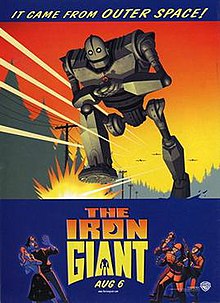
I think one of the most poignant scenes of this movie is the moment we finally get to see humanity from the Giant’s perspective: after Hogarth tells him that the bomb will kill everyone, he looks down at all the little people scattered on the ground before him, and at the shops and buildings no bigger than snackboxes. With a few strides of his legs he would be free of the blast radius, or he could simply fly away. It’s just a little place on a world he isn’t from, and he doesn’t have to be a part of its problems at all.
Here is the original write-up that I did of the Iron Giant a few years ago.
Last night I watched it again and had a few additional thoughts that I wanted to get down.
1. The Post-War Setting
Hogarth’s father has been killed in action, that much we can get from subtle hints through the movie:
Hogarth’s Mom is having financial difficulties and works as a waitress, renting out the room in their large house.
There’s a photo of a man climbing into a vehicle cockpit on Hogarth’s bedside table
One of the pictures that Mansley develops from Hogarth’s camera is of both Hogarth and his mom, begging the question, who took the picture? I’m guessing his Dad, before he went away
Annie calls Dean “sweetie” at the movie’s end and has clearly developed a relationship with him, indicating Hogarth’s dad is permanently out of the picture (unless Annie is rocking some seriously progressive relationship dynamics).
But there was something I noticed about twenty minutes in. I had absorbed it but never really thought about the other people in the town – it’s almost all women, kids, and older men. And I realized that it’s because all the younger men were called up for service in the war. And more than likely, didn’t come back. If that’s something intentional on the part of the filmmakers, then BRA-VO. That is a beautifully subtle reality of post-war life.
If this is accurate, then it also adds another layer of subtlety to Dean and Mansley’s characters – Dean might be a conscientious objector; the way the other men in the diner sort of dismiss him could just be because of his beatnik stylings, but it could also be that he’s thought of as a “draft dodger.” And Mansley was left behind because he’s just plain incompetent.
2. Hogarth’s Reaction to Death
Hogarth is a sensitive, intelligent, and creative boy. He saves the Giant when the latter is endangered at the power station. When the Giant destroys the traintracks, he is horrified at what could happen. When he and the Giant encounter the deer and the hunters, he gently tries to describe what happened to the deer, and is incensed when the Giant tries to pick the body up.
Additionally, he has a serious talk with the Giant about souls and what happens when you die. He quotes his mother’s belief in souls, and I imagined his mother having this discussion with him after his father passed away. It’s a terrible thing, to bury a loved one, and he doesn’t want anyone to experience what he went through, especially not at his expense.
3. Hogarth As Father Figure
Hogarth finds this creature, takes him in, and extends hospitality to him. He helps him find food, and a safe place to stay. He becomes the Giant’s protector, in a lovely role reversal. It’s not every ‘boy’s movie’ where the main character is a protector or nurturer. At very few times during the movie is Hogarth in danger – it’s the Giant who is in the most danger. At the end, Hogarth again saves the Giant by arguing with the General that he is not dangerous, although Mansley borks that plan by grabbing the telecom and commanding the Nautilus to fire its atomic weapon. The boy and Giant are literally following the roles of Jonathan Kent and Superman, and just as in that story, the child (Giant) matures and assumes the role of protector.
I think one of the most poignant scenes of this movie is the moment we finally get to see humanity from the Giant’s perspective: after Hogarth tells him that the bomb will kill everyone, he looks down at all the little people scattered on the ground before him, and at the shops and buildings no bigger than snackboxes. With a few strides of his legs he would be free of the blast radius, or he could simply fly away. It’s just a little place on a world he isn’t from, and he doesn’t have to be a part of its problems at all.
The Giant is destroyed in his role as protector, but as we see at the end of the film, he isn’t really gone. He’ll be back, and OMG I get emotional just WRITING about it. And Hogarth has a father figure again, both in Dean, and in the Giant, who’ll be returning soon.
4. Giant as Russia
Obviously, the film’s big themes are the Atomic Age and beginning of the Cold War. Dean literally tells the General that the Giant “will not attack unless he’s attacked first,” which was the entire situation of the Cold War. There’s even a joke about the Giant not wanting to be Atomo, the atomic robot villain.
Additionally, the fear and hatred whipped up in the townspeople by Mansley is also ephemeral once they realize the Giant poses no threat, and is even as invested in peace as they are. And, just as in nuclear holocaust, when you’re about to die the lines between hero and villain kind of fall away, since there’s no time left for such distinctions.
So those are the thoughts I thunk while watching it again last night. I do love a good, layered film that makes you think, and that you can see differently if you go back to it.
I hope you’re having a great day! If you haven’t checked this movie out, you might. It’s not on Instant at the moment but it’s widely available elsewhere.