‘I was surprised by how much I hated this’ entry: St Elmo’s Fire

First and foremost, I am totally a child of the 80’s. There are a lot of Brat Pack movies I missed the first time around, wholly because they were about people coming to terms with things and not little monsters who ruin things, unicorns, or singing and dancing magic men. I did see The Breakfast Club in high school, so I’ve got that going for me.

I am not fit to be a parent because I would spend all my time saying 'I wish the goblins would take you away right now' in hopes of meeting this man.

That said, I’ve slowly been catching up. When I saw that St. Elmo’s Fire was on instant watch, I thought ‘well, I guess now’s the time.’

And let me absolutely crystal clear–I am not posting this negative review just to bash the film–I was genuinely surprised by how much I didn’t like it. I usually like all the actors appearing in it–but in this case, the sum was somehow less than its parts.

From the very first few seconds, as all the recent graduates walk along with their arms slung about each others’ necks, I got a sinking feeling in my stomach. There’s no more facile way to show ‘We’re all friends!’ than the ‘let’s all walk together with our arms around each other’ walk.  No one does that except in photo opportunities and movies. It always comes across as fake to me, so my very first read on these people is that they are fake.

Then comes the opening scene in the emergency room, and I sort of already didn’t like anyone–especially when it turned out one of the friends was responsible for the accident. There was a little too much quipping, and the dialogue had that overly-rehearsed feel.

The rest of the movie went about the same–when Billy is on the roof of Wendy’s parents’ house and the whole family is outside clutching their pearls in shock it felt like overwritten, overwrought hysteria. Billy was less a badboy than a needy douchbag, Alec an entitled prick, and Kirby was just plain psycho. The female characters didn’t fare much better–I would have been more interested in Wendy’s arc if the film hadn’t tried to convince us she was overweight by having her wear bulky sweaters and embarrassing old-lady drawers. Mare Winningham is one of those actresses whose appearance always has me wince a little and say ‘Jesus woman, it’s called protein–make friends with it,’ so casting her as a ‘fat’ girl just felt like an insult. I’m 5’2 and go about 160–by this movie’s logic I would be a bedridden monstrosity, a human waterbed, and have to exit my house through a hole cut in the wall.

Leslie was a little more sympathetic, but felt like such a bland doormat that her epiphany towards the end of the movie felt less like her own doing than Kevin’s and Alec’s. If Alec’s infidelities hadn’t been brought to light, I doubt she would have refused his offer of marriage.

(That’s another reason I’m not crazy about this movie–relating all this bullshit makes me feel like I’m watching paint dry. I hate that I have to describe all this boring pap.)

Jules’ portrayal was a step in the right direction, but her asinine behavior at the homeless shelter (SEE? PAP!) completely negated any goodwill I had towards her. She’s an independent woman with a good career and her own apartment, when two of her male counterparts are sharing a little crappy apartment–except her Daddy’s rich, she has a severe coke habit and she’s sleeping with her married boss. See girls? Career women are never happy.

I’m glad I checked Rotten Tomatoes–apparently I’m not the only person who hated this movie. Even Ebert put it on his ‘Worst of 1985’ list, and if you’ve pissed off Ebert, you’ve seriously, seriously fucked up as a filmmaker.

The problem with this movie is that the problems these people are facing are the kinds that other people WANT to have. ‘I’m a privileged white person in the 80’s who is afraid of the possibility that the rest of my life won’t be as awesome as being a kid was. I’m going to bitch about it and make a few missteps but then everything will turn out okay.’

OH MY GOD! SOMEONE ALERT OSKAR SCHINDLER TO THE PLIGHT OF THESE PEOPLE!

'Some privileged white people in the 80's need help? That is truly a crime against humanity!'

I tend to think of the 80’s as a very good time for fantasy movies. But while some fantasy movies were overt about their messages and at least had the balls to have a few monsters or something to illustrate their point that you know, this was not based in reality, there’s another form of 80’s movie altogether that offered the same escapism but none of the honesty. I can’t help but think of St. Elmo’s Fire as an example of this latter–while the nation battled a recession, political scandals with the whole Iran-Contra thing, soaring rates in illiteracy and drug use, and a host of other REAL problems, the characters of St Elmo’s Fire dealt with some major First World Problems. You know what, not even First World Problems, because people in the first world can still experience racism, homophobia, mysogyny, anti-semitism and economic disenfranchisement.

These people are experiencing the horror of not having their Upper Middle Class dreams come true. Meanwhile, the real horrors of adulthood are things like compromising your dreams to support your family, having a child you can’t afford, taking care of an infirm family member or parent, or being passed over for promotions at work because you don’t know how to play office politics.

You know what this movie needed to give these people some perspective?

Principal Joe Clark.
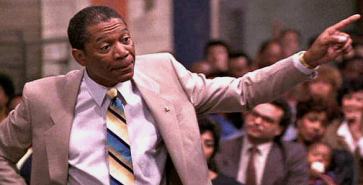
'What's that? Becoming a grownup after you've graduated from Georgetown University is scary? WELL MY GOD, GET THIS BOY A BLANKIE AND A THUMB!'

The Downward Spiral of the Predator

Consider the first act of Predator–an elite commando squad lands in the jungle and takes out a badass drug operation. Maybe not the most original set up, but it introduced you to these guys as they really are: supercompetent badasses who operate as a unit, and who literally laugh in the face of danger. This is the Schwarzeneggar of Commando, of the Terminator, of Conan. He wakes up to a big breakfast of explosions and fistfights, and sprinkles gratuitous violence into his coffee.

I haven’t seen the new Predator movie. I want to, and I might see it in the theater and I hope that it’s good, but today’s post is more about the Predator franchise in general, and what it means to me.

Here is a pic of the exact same poster I had on my wall when I was 13.

I want to believe some little boy out there had one of My Little Pony. Because we would be bestest friends EVAR.

Bitchin, eh?

In 5th grade, I had a few male friends who accepted and appreciated my status as tomboy.

In 6th grade, the game changed.

My middle school was  pretty crappy one, as schools went. Most of the kids were biding their time until they could drop out, and there were always stories on Monday morning about what illicit behavior people got up to over the weekend, especially stories about older brothers or sisters in gangs. I was one of few white kids, and what’s worse I was in regular classes because of my orchestra class. Yes, I played violin. I was just that cool.

I tried to make friends.  But the one nut I couldn’t crack was the Comic Book Kids. They were a group of kids who hung around at lunch talking comics, all attempting to recreate the drawings or make up their own characters. Because I could draw I would sit with them and just listen to their talk, but if I said anything I was immediately shut down for my lack of knowledge. Only one kid would talk to me, a kid named Jose who at age 13 made the work of Todd McFarlane look like the scrawlings of  a palsy victim. He was  a genius: his work had depth, he had an advanced knowledge of musculature, form, and he even knew how to block out a drawing before he started. Best of all, he was my friend and he’d actually talk to me about my drawings.

But he also started telling me about a movie one day, an incredibly awesome movie that he’d snuck into the theater with his brother to see: a movie called Predator.

I wasn’t about to tell him that I’d seen about .4 seconds of it, while I was walking through the living room and my parents were watching it, and I’d hurried to my room because they were watching a ‘grown-up’ movie. Or maybe I did tell him. However it happened, I wound up watching it one weekend, and absolutely fell in love.

When the second one came out in theaters I knew my parents wouldn’t let me go see it, so when I went up to visit my Aunt over the summer I totally rented that shit. It wasn’t quite as good as the first one–even at 13 I realized they had just amped everything up, and to see it now is to contain barely-restrained laughter at the profanity, the violence, everything. It’s so ludicrously over the top for an action movie it approached parody, even in the early 90’s.

I freaking love the first Predator, the second is like an alcoholic uncle I enjoy spending time with but ultimately wish I could save in some way, and the AVP movies are like cousins who should have been aborted in the womb and ruin every family gathering with their existence.

The first AVP was a decent effort, despite its PG-13 rating. I won’t lie, as a nerdy teenager it was my secret dream that a Predator would land and we would totally be BFF. He would teach me how to hunt and crush my enemies, and I would teach him how to play ‘Happy Birthday’ on the violin. It would have been a perfect life. So the whole woman working with a predator against the aliens was kind of neat.

AVP2 reminded me of an experience in real life I’d like to share. I went to the dentist after skipping cleanings for  few years, and learned something interesting: once you hit your late twenties, your gums recede away from the roots of your teeth, exposing more sensitive nerves. This explains why going regularly for cleanings is important–becuse when shit builts up at the base, on the roots,  scraping it off with a metal hook is incredibly painful. I almost blacked out the last time, and I have been a dental regular since. I remember my hands kept drifting up towards the woman’s arm and she had to push them back down, and it was NOT OF MY DOING. My body was rejecting the whole procedure and I wanted it to stop, but also knew it had to be done.

AVP2 was kind of like that. An experience that had once been familiar, even somewhat pleasant when I was younger, became an exercise in nightmare once I was an adult. I think I just demand too much–after all, the first Predator has a lot going for it for a ‘dumb action movie.’

Consider the first act of Predator–an elite commando squad lands in the jungle and takes out a badass drug operation. Maybe not the most original set up, but it introduced you to these guys as they really are: supercompetent badasses who operate as a unit, and who literally laugh in the face of danger.  This is the Schwarzeneggar of Commando, of the Terminator, of Conan. He wakes up to a big breakfast of explosions and fistfights, and sprinkles gratuitous violence into his coffee.

In the second act, when Shit Gets Weird, you see something that seems incredible: these men, these men torn from the thigh of Zeus and who came from On High to Beat Ass, are  . . . frightened.

Now, I am certainly not making the claim that the acting in Predator was unfairly snubbed when it came Oscar-Time. Lord no. But, when these men, these ridiculously overmuscled, walking testosterone doses of men act frightened, it feels earned. It feels like they have every goddamn right to be afraid–for one thing, they’re battling their worst enemy, a hunter stronger, faster, and more technologically advanced than they, who is doing this FOR FUN, and for another, they have been lied to by their government. This was a time in movies when that wasn’t taken for granted, when it wasn’t happening in every film that came out, so it doesn’t feel cheapened by oversaturation.

For another, you couldn’t have asked for better casting. You’ve got the big, muscular guys like Arnold, Carl Weathers (!!), Sonny Landham, and Bill Duke, who may lack bulk but makes up for it with one of the best death scenes in an action movie EVAR. Jesus, I almost forgot Jesse Ventura–there’s so much beefcake I FORGOT ONE. The concepts, like the biceps, are just too big.

Not Pictured: Estrogen

Then there are the littler guys, whose names escape me but who were awesome in their own right, with the jokes and the drama and whatnot.

My point with all this is that any Predator movie has some big goddamn shoes to fill.

It seems like in any pitch meeting for a Predator movie Jack Donaghy from 30Rock ought to pop in an ask ‘Are you ready to put on your Daddy’s shoes yet, boy?’ and any answer except ‘Yes sir, I wore them today, Sir’ will be met with bitter failure. So even though I don’t mean to, I have some pretty high expectations for any Predator movie.

AVP2 was such a bitter, bitter disappointment to me, and while I don’t read every Predator comic that comes out (I know their species name starts with  Y, but damned if I can remember it and I’m not looking it up) I do love the franchise and the world it inhabits. I don’t get why the movies are so lacking in quality lately, either; it’s not like the Predator is an actor who isn’t aging well and can’t do the stunts because of his bad back. IT’S A COSTUME. It requires a different actor each time! Although I do like the idea of a broken-down Predator with a potbelly and a 2k a day coke habit begging some studio exec for one more shot, one more bite at the apple. ‘Come on, Jimmy, you know I’m good for it, you know I can bring it! I’ll get clean, I’ll learn my lines, I’ll train with the same guy who brought Stallone back!’ George Burns was right, show business is  hideous bitch-goddess.

That said, the Predator itself is only the co-star of the movie. If the real stars of the movie don’t represent the humans and bring at least a little pathos to the table, then what the hell’s the point of rooting for them? Why did they bother in the first place?

Yes, we CAN all get long in the face of a hideous anthrophagic alien species! Why is this not on a poster in a classroom RIGHT NOW?

80’s Vampire Spectacular: My Best Friend is a Vampire

That's just damned good poster design right there.

The next entry in our 80’s Vampire movie Spectacular is My Best Friend is a Vampire, starring  a pre-Dead Poets Robert Sean Leonard, Rene Auberjonois and David Warner. Although it came out after Fright Night, I saw it before FN because Best Friend is rated PG and I believe FN was R. Best Friend is also a little more campy and fun than FN, which made it great sleepover viewing.

Best Friend is about teenager Jeremy, who is nursing a crush on a band geek (who is somehow inexplicably able to blow him off with the same snottiness as if she were Queen of the Cheerleaders) and just trying to survive high school. One day, as he’s going about his job delivering groceries he encounters Nora, the kind of 80’s hot girl that pops up in these movies like high-tops–sultry, alluring, and for some reason interested in sweaty, inexperienced teenage boys. She turns him into a vampire, and wacky hijinks ensue as he tries to figure out exactly WTF is going on. Moments after Jeremy’s deed is done, David Warner enters the scene as psycho vampire killer Leopold, who kills Nora and chases Jeremy from the house.

Enter Rene Auberjonois as Modoc, a super-smooth vampire with a bitching BMW and a cup overflowething with awesome. He’s shown up to help show young Jeremy the ropes and keep him out of trouble. It’s kind of nice if you think about it–sure, it ensures the survival of the vampire species, but it’s also kind of nice to think of an older, experienced vampire out and about, on the prowl for some claret,  and suddenly slamming on the brakes and declaring ‘My NOOB-sense is tingling!’ Then making up a care package of pig’s blood, sunglasses and arty hats.

While Fright Night approached the gay thing obliquely, coding so hard you’d think it was 1990 and the film a LINUX enthusiast, Best Friend hits it head on–Jeremy’s parents observe him hanging around with an older, ‘European’ fellow, driving the fellow’s car with its suggestive ‘NITEMAN’ vanity plate, partying all night and sleeping through the day, and react accordingly for an 80’s parent: they begin reading books on how to talk to their gay son. The entire thing becomes a secondary-story joke, as Jeremy goes about his vampiric adventures battling the vampire killers his parents are often in the background trying to come to terms with the fact that their son probably won’t be producing grandchildren.

There are other literal gay winks, as well: Jeremy, in the throes of bloodlust, visits an all-night butcher and requests a pint of pig’s blood. When the butcher presents it, he winks at the young man and asks if it’s ‘his first time.’ I have no idea what this could be a double-entendre for, but the direct meaning is that the butcher knows all about vampires and is amused by this awkward young man.

Best Friend was also one of the first vampire movies I’d seen that posited that being a vampire wasn’t all that bad: sure, it’s a lifestyle change, but there’s a LOT of good stuff that goes into it. The eternity thing is tempered when Modoc tells Jeremy that for every decade he will age only a year, so there’s still the ‘you get to watch your loved ones grow old and die’ thing, but the rest of the package is awfully alluring. Plus its all a moot point since Jeremy can’t be changed back, unlike in other films where killing the head vampire cures all the ones he’s changed.

There’s a lot to like about Best Friend. Sure, the jokes are sometimes groan-worthy and its fashion hasn’t aged well, but at its heart it’s a story about accepting and even celebrating who you are, even if that is different from the norm. Even now, that’s an awfully positive message: how many films about gay men and women today have to explore their feelings rather than just accept that they are gay? When will we see a mainstream horror or action movie with a gay protagonist that isn’t an allegory or that offers some explanation for the character’s orientation?

Jeremy may hang around with vampires in the future, but he’ll still have time for his human friends. Cheesy? God yes, but cheese makes everything better, even salads.

Best Fiends Forever! Yay Vampires!

80’s Vampire Spectacular: Fright Night

Fright Night is a hoot. There’s something damned sexy about it even after all these years, after Buffy, Angel, Gary Oldman, the Anne Rice years, and Let the Right One In (I am NOT a Twilight fan) it’s fun to see vampires being scary and evil again, instead of pretty and conflicted.

Someday the internet will be 3D, and this will be so much awesomer

Who doesn’t love the simplicity of 80’s vampire movies? With Fright Night 1 and My Best Friend is a Vampire available on Instant Watch, I decided to do a couple posts about this most joyous and fun of horror movies, 80’s Vampire movies. If only The Lost Boys, Fright Night 2, Vamp, or any of the others were on it, then we’d be cooking with canola.

Fright Night combined some of the best parts of the vampire genre with all the fun of the 80s– ludicrous outfits, unsubtle synth scores that practically screamed ‘FUCK YEAH VAMPIRES!!’, teenage angst, oblivious parents and authority figures– and dusted everything with a light tinge of homoeroticism.

To wit: Charlie Brewster is a young man frustrated with his girlfriend’s fear of Going All the Way. Remember when teenagers used to be afraid of that? I do, because I was one. And they still are, but films and TV would have you believe that every shy girl has either blown half the drama club or she’s saving herself for the magical day with her angsty vampire boyfriend finally is able to commit and murder her. Ahh, young love.

Brewster and his young lady are making out one night when some activity at the abandoned house next door distracts him from the activity almost going on in his pants, and he ruins the mood by watching two mysterious men carry a coffin into the basement next door. Enter Jerry Dandridge, played by smooth motherfucker Chris Sarandon (best known as Prince Humperdinck from The Princess Bride, and as the speaking voice of Jack Skellington in The Nightmare Before Christmas) and his ‘live-in carpenter,’ Billy, acting all suspicious in the mist and rocking some of the bossest Members-Only jackets since Scott Baio was in charge.

Until recently, I wasn’t able to put my finger on why I thought of Fright Night as ‘The Vampire Movie with All the Latent Homoeroticism’. Well, I’ve figured it out.

Roddy MacDowell is the first reason–an actor whose sexuality was long speculated upon and has still yet to have been confirmed. For some reason, he threw up the first rainbow flag, despite the fact that his character is NEVER alluded to as gay. He does have the confirmed bachelor thing going on, but it could also be that he is a failed actor too neurotic to have a relationship. Or the budget didn’t allow for him to have a wife–but his apartment, with all its relics of the horror movies he’d acted in, seems like the old man version of the nerdy teenager’s den festooned with posters and props.

The second is the complex interaction between Brewster and Dandridge. Brewster’s father is absent, so Dandridge could be filling that role as Charlie’s mother expresses an interest in the handsome fellow but speculates that with her luck, he’s probably gay. Dandridge comes across less as gay than as an ultimate Pansexual Alpha– women stream into his house (and are drained of blood) and men respond to his easygoing charm. Also, his live-in ‘carpenter’ is always on hand to protect him or toss him ‘fruit.’ This last is no euphemism, Dandridge is CONSTANTLY snacking on apples, peaches, all kinds of fruits. So, there’s that lack of subtlety. Sarandon plays Dandridge as incredibly affable and charismatic–he doesnt’ quite have perfect movie-star looks, but he’s good-looking and oozing with charm. He doesn’t exactly light up a room, but if you saw him hanging out in the corner of a bar you’d probably notice him, think he was out of your league, and when he ambled over and struck up a conversation you’d think ‘Oh wow! He’s talking to ME!’ He’s just that guy.

To be honest though, there are moments when he looks little amused or bored by the goings-on; in the big moment where he is about to seduce Amy, he crosses the room to her with the same look I get on my face when I’m approaching my shitty old lawn mower on a really hot day. But this look of ‘been there, done that four billion times’ is tempered by their actual make out scene, in which she is frightened and shy, and he gentle and assured. It’s one of the hotter scenes of its kind in memory, and not much in recent years is as provocative.

Another P-Flag moment  is when Charlie’s friend Evil Ed is turned into a vampire by Dandridge. Ed is cowering in an alley, terrified and weeping as the vampire stands before him, and Jerry, as kind and affable as always, reaches out to Ed and tells him that he won’t have to be afraid anymore, that no one will ever beat him up again, that Jerry will look after him. Ed’s character is definitely the stereotypical horror nerd, with more knowledge of how to kill vampires than have a normal social interaction with his friends, but the promise of being the one with the power, and of being accepted, is too much for him and he takes Dandridge’s hand.  The mentor/mentee relationship is not subtle either, and open to wide interpretation.  Nowadays a person can build their confidence about their sexuality by interacting online with other people and create a support network, but in the 80’s coming out was a whole different banana. It was scary and confusing and not helped by the media painting gay men as potential kiddie-fiddlers and rapists, or the specter of AIDS–and it could be very, very lonely.

Also, the actor who played Evil Ed went on to act in several gay porn films, so perhaps that subconsciously informed my urge to go rainbow hunting where there were no rainbows, so to speak.

Anyhoodle, for me, much of Charlie’s struggle against the vampire is about his refusal to accept his own problems with sexuality; he whines in the beginning of the movie that he and Amy (Amanda Bearse, doing her best to be both prude and vamp and doing pretty well despite the orange hair) have been going together a year and still haven’t had sex, yet when she declares that she is ready he’s too busy peeping at the neighbors to take her up on it, and she storms out. Clearly, he’s not emotionally ready for sex, and when Dandridge begins seducing a chick in view of Charlie, the latter is only too ready to bust out the binoculars again. He might just be excited at the chance to watch, but perhaps he’s also excited to find out just how to get down at all.

Dandridge sets his sights on Amy because she bears a resemblance to some chick he knew in the past, and this is a story point that the film could have done without. I think it would have been much more interesting without that, if Amy had gone with him because she was tired of Charlie’s immaturity and wanted something with a little more grown-up styling. Dandridge is confident, mature (probably hundreds of years old), and experienced–everything Charlie isn’t. And since Jerry is out to screw Charlie for drawing attention to his vampiric nature in the first place, Amy is a natural target. So another friend betrays Charlie in favor of a stronger, more assured leader.

One of the more interesting points in the film is when Dandridge puts a huge amount of trust in Peter Vincent, MacDowell’s aged fake vampire killer. The friends conspire to prove to Charlie that Dandridge is not a vampire, and in order to do this have him drink ‘holy water’ in front of them. Dandridge does it, and if you think about it it’s a strangely trusting moment on his part–after all, he could just kill the three of them and go back to nailing prostitutes and hanging out with his houseboy. Why does he want their trust so badly? Does he really see feeble, paranoid and immature Charlie as a threat? Is it more important to him to be liked than to be feared?

Fright Night is a hoot. There’s something damned sexy about it even after all these years, after Buffy, Angel, Gary Oldman, the Anne Rice years, and Let the Right One In (I am NOT a Twilight fan). It’s fun to see vampires being scary and evil again, instead of pretty and conflicted. Half the reason they’re sexy to begin with IS that they are scary, that they offer something truly evil and selfish rather than just mediocre and whiny.

4 Life Lessons from 4 Classic 80’s Movies

Every culture in the world will eventually produce a set of maxims for behavior; from the laws of Nebuchadnezzar, to the doctrines of Thomas Aquinas, to basic Internet Etiquette, there are morals and suggestions for human interaction everywhere–you could trip over them and someone would be there to tell you what you did wrong.

While drunkenly sobbing at the end of The Princess Bride, our previous entry, I realized that a set of films I’ve grown up with contained some of the best advice I’ve ever gotten when it comes to life.

4. Gremlins

Moral – Follow the Rules

“When an old Chinese man tells you to do something, you better by god do it.”

As Americans, we value rugged individualism. We carved this country into existence with our will, with guns, with good old fashioned gumption, and without any shame when it came to screwing over someone else.

Everything that Christmas means to me, including electronics and mythological beasts.

So when some old Chinese guy tells Rand Peltzer The Rules:

1. Do not Expose to Sunlight

2. Do not Get Wet

3. DO NOT Feed After Midnight

. . . it’s understandable the old fellow takes them to be foolish superstition rather than anything worth listening to. It’s worth noting that Peltzer is an inventor–after all, America was built on individuals with the courage to challenge the status quo, to ignore boring old tradition, to invent ashtrays that allowed assholes to smoke anywhere they want!

The funny thing is, this is a much more clever metaphor than you think at first, and also an apt observation on the American mindset: after all, we have a tendency to think that no on in earth’s history has ever dealt with the things we have. Civil rights? NO ONE EVER has thought about that–certainly not the Persian empire upon ruling their conquered subjects. Some people are GAY? That’s never happened before and we as Americans are the only ones who accept that this strange new thing exists–let alone are trying to legislate it. An argument concerning a strong federal government versus states’ rights? NEVER! NEVER ANYWHERE!

With all the knowledge available in the world, especially now, it’s incredibly easy to study history in order to prevent its repetition. After all, making the herculean leap that someone else MIGHT know a little more than you about something can be surprisingly interesting. Does that mean following the rules is always the right thing to do? No, as we learn when Billy exposes the marauding Gremlins to light in order to save the town. Breaking the rules about sunlight turns out to have been the right thing to do. Now if only they’d followed the goddamn rules in the first place.

3. The Goonies

Moral – You have to grow up some time.

Ahh, the Goonies. If there’s a better movie to watch while eating pizza, drinking soda (or beer, or both!) and eating ice cream, it’s probably in my Instant Watch queueueueu.

It's also about friendship! Scary, hideously disfigured friendship.

The truffle shuffle, Data’s gadgets, Mouth’s sassy Spanish harassment of a terrified housekeeper, the whole shebang. It’s a glorious romp about childhood, adventure, fun, and saying ‘shit’ in a PG movie.

But the meat of the matter (not Chunk)  is that at some point, kids have to stop being kids.

Mikey’s speech is a deliciously syllogistic call to arms for kids: ‘Down here it’s our time. It’s our time down here!’ he cries as he attempts to rally his group of  misfits into searching for the lost pirate treasure rather than going home to safety and being separated. Their parents have always done everything for them, and now it’s time to do something for them. It’s a cracked window into adulthood, coming at a  time when a young person may still be able to slide the pane closed and turn back to childhood.

I have several friends who, now in their late twenties and early thirties, are living the truth of this.  Parents age, they become sick, and eventually, they will cease to be. Parents take care of kids (hopefully–an afternoon at the mall sometimes destroys all hope of civilization’s future) and after the kids are grown and out of the house, they take care of their parents.

Of course there are other meanings, other ways in which we grow up. People have kids, buy houses, cars, start businesses, get promotions, and all of that is great but comes with a cost– their kids aren’t copies of themselves and there’s a generation gap, their houses lose value or are lost in a disaster, their business fails, they get overlooked for promotions in favor of the boss’s son or daughter. Joy and sorrow, triumph and failure–it’s all a part of life. For a single moment in a movie over 20 years old, we all had a glimpse into that frightening world, and then it was back to wacky antics and slapstick.

2. Labyrinth

Moral – One person has no power over another

By the end of Labyrinth, I am usually completely sold on Jereth.

Not Pictured: David Bowie's Area. But it's there . . . Oh yes. It's there.

Though he puts Sarah through hell, endangers her baby brother, and probably wreaked a number on the Ozone layer after the application of all that Aqua Net, I am ALWAYS cheering and waving a little flag that reads ‘DO HIM!’ by the end.

But I digress.

Sarah, as young girl, is just beginning on the path to adulthood–part of which is negotiating the Throbbing, Moist, Thrusting Swamp of Sexuality, the set of which was probably too expensive to build. That’s the reason I’m guessing anyway.

Part of making it through that wilderness, oh yes she made it throoooogh, is learning how much of oneself to give to the other in a relationship. It’s about learning how to say ‘No’ to someone that you’ve trusted enough to experience those first steps of physical intimacy, which can be downright terrifying. It’s about learning that crucial difference between wanting someone and needing someone.

There’s a huge amount of pressure on young people to conform to societal standards, especially when it comes to sexual interactions. Sarah’s refusal to accept Jereth’s invitation of taking part in what seems like a dysfunctional relationship is a great example for people, male or female, about relationships. If it isn’t about equals, it’s about power, and there’s enough bullshit in the world concerning that.

1. The Princess Bride

Moral – Life is Pain

At 8 years old the first time I saw TPB, there was a lot to be afraid of: the shrieking eels, the ROUSs, Inigo’s wounds at the end of the movie (I thought he was going to die–HELLO TRAUMA), and the Grandfather’s taking a moment (just as happens in the book) to warn the viewer that Some of The Wrong People Die. But the moment that really stopped my tiny, sheltered heart was the Man In Black’s cruel words to Buttercup about the death of her beloved Westley: “Life Is Pain. Anyone who says something different is selling something. ”

"And you know what else? THERE IS NO SANTA."

The Man in Black has no reason to lie to her, at this moment. In a way, he did kill Westley, as the innocent farmboy she knew is gone, replaced by a fierce, dangerous man of action.

This simple assertion by the pirate that life isn’t fair almost seems like a stupid thing to say to Buttercup–after all, she fell in love with a young man who immediately was murdered by pirates (in the book, it’s clear he’s gone out to make a place for himself in the world, after which he’ll send for her–not exactly a paragon of Women’s Lib, but it is what it is) and then she was chosen to marry and bear children for Prince Humperdinck against her will. She knows full well that shit happens, yet when he barks that line at her, it’s immediately clear that she was hoping for some form of rescue, of fairness in her fate. Essentially, though shitty things have happened to her, she’s still the heroine of the fairy tale until that line breaks through–now she understands the reality of the situation, that this is no fairy tale, that she very well might die.

The moral of this story is that whatever expectations you have, be they low or high, things won’t always be pleasant, and they certainly won’t be fair. Expecting life to be fair is ridiculous, but hoping for it to be is an entirely different matter. It’s hope, after all, that makes life worth living.

So what are the deep, philosophical meanings behind this?

I’m no Existentialist– when asked ‘Why?’, I reply ‘Because.’ People exist on this planet because of a marvelously complex series of absolute coincidences, a series of events so random that the math to quantify it barely exists. And yet we are.

I’ve always found stories, in the form of books, history and movies, a helpful way to understand the world–seeing the reproduction in an art form, as simplified or unrealistic as it is, can sometimes help in dealing with the incredibly abstract reality. Obviously this isn’t the only way to view the world, but it helps.